CHAPTER 1 – THE BOX
“Take the rest of the day, David. Security will walk you out.”
Mark Sullivan said it standing in my doorway with two guards behind him, loud enough for the whole floor to hear. That was the point. It was always the point with Mark.
I’d worked at Halcyon Logistics for eleven years. Started in dispatch, worked my way up to senior operations manager. I knew every route, every vendor, every line of the quarterly reports, because for the last three years, I’d been the one quietly fixing them before Mark presented them to the board.
“Can I ask why?” I said.
“Restructuring.” Mark didn’t look at me. He looked at the guards. “He’ll need a box for his personal items.”
The floor went silent. Forty people, and you could hear the air conditioning. Priya from accounting stared at her keyboard. Old Tom from the warehouse, twenty-three years at Halcyon, took off his glasses and cleaned them, which is what Tom does when he doesn’t want you to see his face.
I packed my box. Desk plant: a pothos I’d kept alive through three office moves. A framed photo of my daughter at her graduation. A coffee mug that said WORLD’S OKAYEST BOSS, a gag gift from my team. Eleven years, and it fit in one box.
Nobody said goodbye. That’s the rule when security’s watching. You keep your head down and you’re grateful it’s not you.
Tom walked me to the elevator. The guards let him. Barely.
“David,” he said quietly, “whatever happened — “
“Nothing happened, Tom.” I shifted the box. “That’s the thing. Nothing happened.”
The elevator doors closed on his face, and I rode down twelve floors with two men who wouldn’t meet my eyes, and I thought about the first thing I’d ever learned in logistics: the manifest always tells the truth, even when the men signing it don’t.
Here’s what nobody at Halcyon knew: not Priya, not Tom, not the board.
Six months earlier, I’d found something in the vendor payment files. A discrepancy. Small at first: a fuel surcharge line that didn’t match the carrier invoices. I dug, the way you dig when numbers don’t add up and you can’t sleep until they do.
What I found was a shell vendor. Meridian Supply Group. On paper, a parts supplier out of Nevada. In reality, a P.O. box and a bank account. Halcyon had paid Meridian $2.4 million over eighteen months for parts that never arrived at any warehouse I could find.
I took it to Mark. My boss. The man I’d covered for, the man whose reports I’d fixed.
He went pale. Then he smiled, that thin smile of his, and said, “David, you’re overthinking a coding error. I’ll have finance look into it.”
Finance never looked into it. But my access to the vendor files was revoked the following week. “System upgrade,” they said.
Then my expense reports started getting flagged. Then my performance review, eleven years of exceeds-expectations, came back “needs improvement.” Then the restructuring.
I wasn’t fired for failing. I was fired for finding.
So on Friday afternoon, I carried my box through the lobby, and the security guard, a good kid named Andre who’d always waved me through, wouldn’t look at me either. I set the box in my trunk and sat in the parking lot for a long time, watching the building I’d given eleven years to.
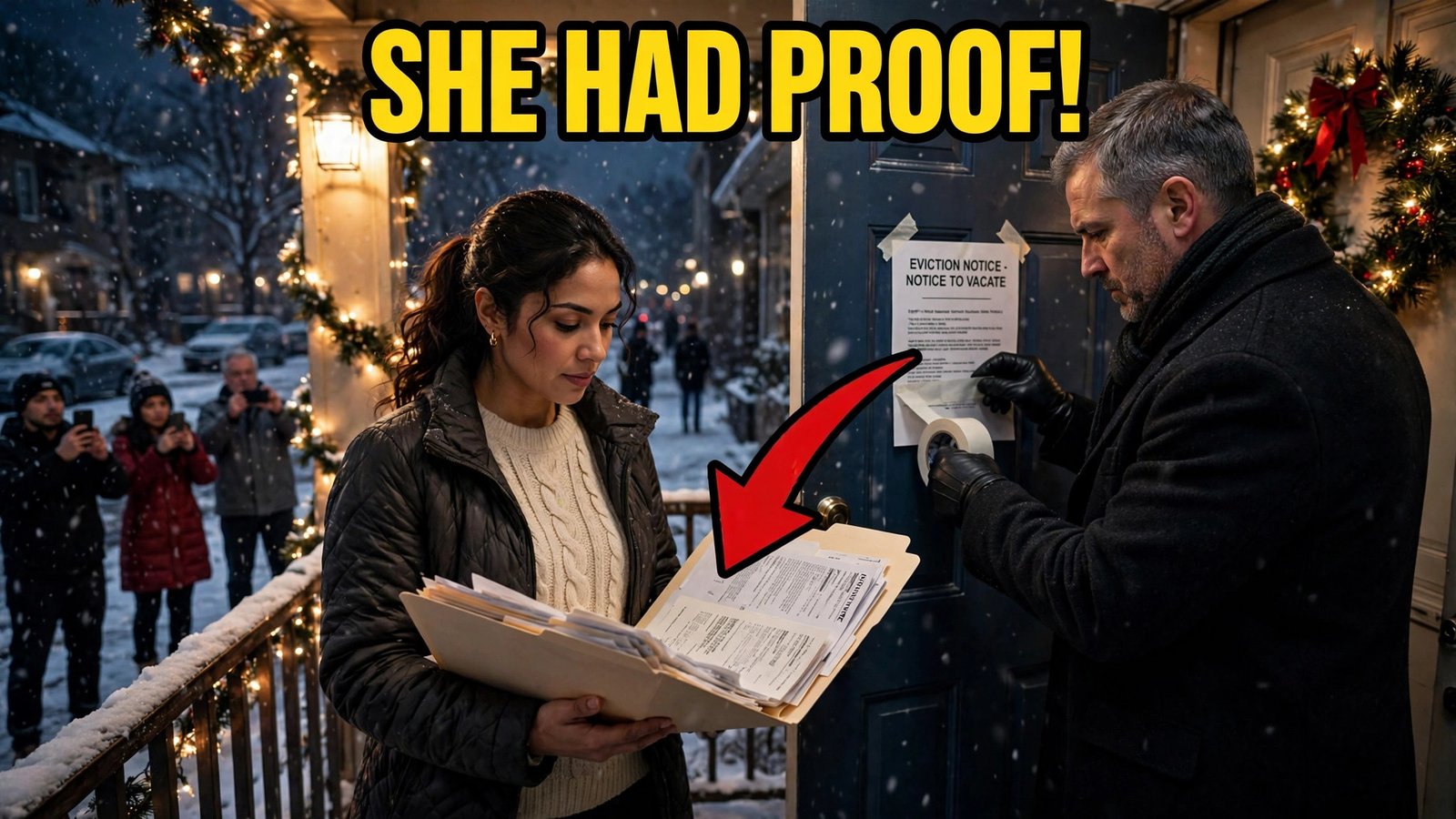
Then I drove home, and I opened the bottom drawer of my filing cabinet, and I took out the manila envelope I’d been building for six months.
Every invoice. Every bank transfer record. Every email where Mark told me to drop it. Copies of everything, timestamped, organized, tabbed. I’d made them at night, a few pages at a time, on my home printer, because I’d learned a long time ago: when you find something rotten, you don’t confront the rot. You document it.
My wife, Lisa, found me at the kitchen table at midnight, surrounded by paper.
“Are you going to the police?” she asked.
“Monday,” I said. “First I’m going to the board.”
She sat down across from me. “David. They fired you. They’ll say you’re a disgruntled ex-employee making things up.”
“Let them,” I said. “Paper doesn’t get disgruntled.”
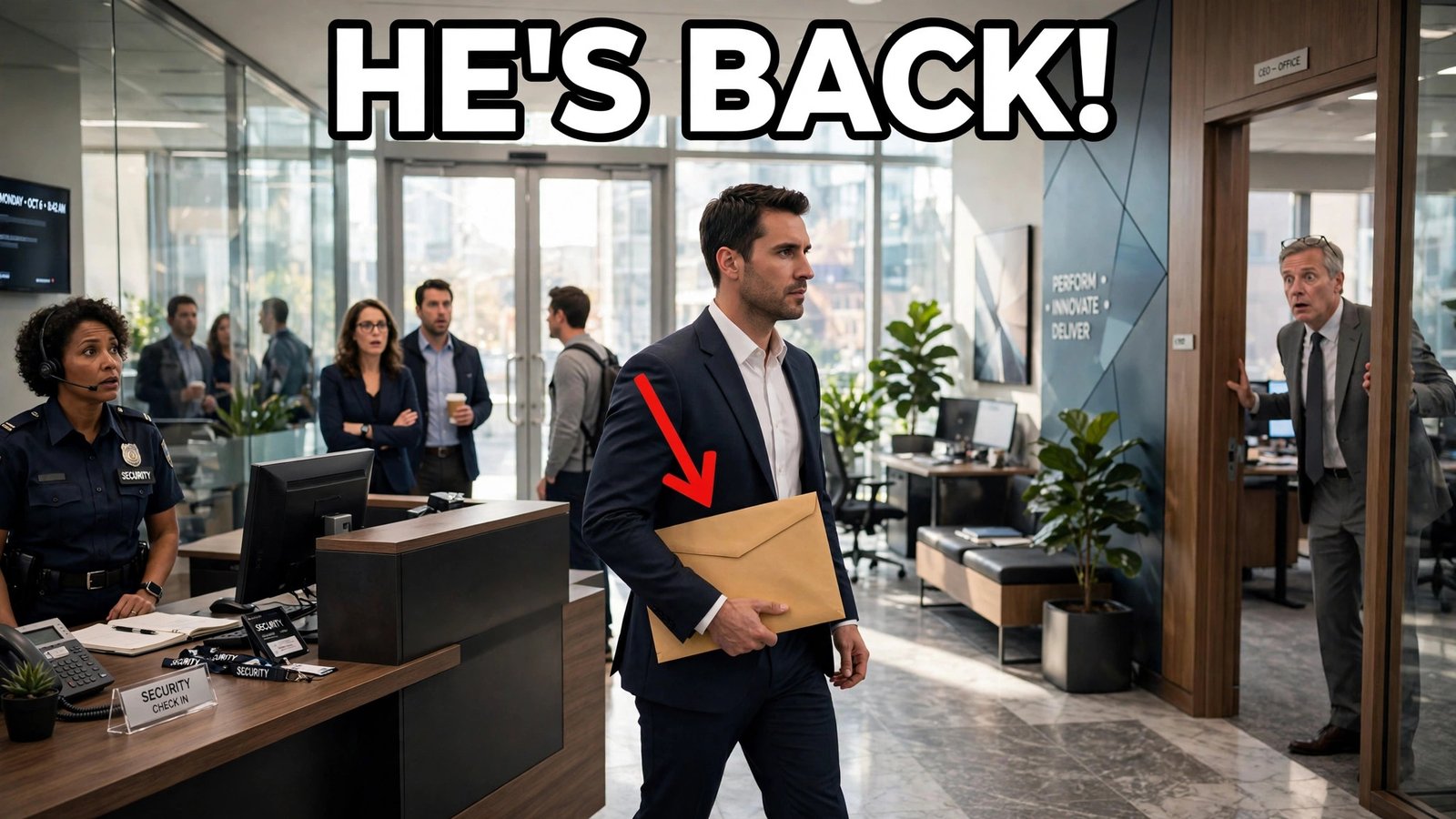
Monday morning, 8:47 a.m. I walked through the front doors of Halcyon Logistics in my best suit, carrying the manila envelope under my arm like a briefcase.
Andre was at the security desk. He stood up fast. “Mr. Mercer — David — you can’t — your badge is deactivated—”
“I’m not here as an employee, Andre.” I set the envelope on the counter. “I’m here as a citizen with an appointment. Board chair’s office. Nine o’clock. You can call up and confirm.”
He called. His face changed as he listened. “They — they say to send you up.”
The elevator ride was the longest of my life. Twelve floors. I watched the numbers climb and thought about my daughter’s graduation photo, sitting in a box in my trunk, and about Tom cleaning his glasses, and about $2.4 million that belonged to the drivers and the warehouse crews whose bonuses had been “restructured” away two quarters running.
The boardroom had a view of the whole yard, trucks lined up like toys. The chair, Margaret Okonkwo, sat at the head of the table with the envelope already in front of her. I’d couriered a copy on Saturday. She’d read it. I could tell by her face.
“Mr. Mercer,” she said. “Sit down.”
Mark was there too, two seats down, and the look on his face when I walked in, I’ll remember it the rest of my life. Not anger. Fear. The specific fear of a man watching his own paperwork walk through the door.
“David,” Mark said, standing, “this is highly irregular—”
“Sit down, Mark.” Margaret’s voice could have cut glass.
She opened the envelope. Laid out the pages one by one on the boardroom table. The invoices. The transfers. The email where Mark wrote “drop this.”
“Mr. Sullivan,” she said, “the board has engaged an independent auditor. They arrived an hour ago. They’re in your office now.”
Mark’s mouth opened. Nothing came out.
“Security will escort you out,” Margaret said. “The police have been notified. I’d advise you to call a lawyer before you call anyone else.”
Two guards came in, the same two from Friday. Mark looked at them, at me, at the papers on the table. He stood up slowly, like a man twice his age.
At the door, he stopped. “David—”
“Don’t,” I said. “You had eleven years of my loyalty, Mark. You spent it in eighteen months.”
He left. The door closed. The boardroom was quiet except for the hum of the air conditioning, the same sound as Friday, but different now. Like the building could breathe again.
Margaret turned to me. “The auditor’s preliminary finding is that you’re right. Down to the dollar.” She paused. “The board would like to offer you your job back. With a promotion. And a formal apology.”
I thought about the box in my trunk. The pothos. The mug.
“Thank you,” I said. “But no.”
She blinked. “May I ask why?”
“Because on Friday, forty people watched me get walked out, and not one of them said a word.” I stood up. “That’s not a company problem, Mrs. Okonkwo. That’s a culture problem. And cultures don’t change because the villain leaves. They change because the witnesses decide to speak.”
I walked out of the boardroom, past the bullpen where Priya was crying quietly at her desk, with relief, I think, past Tom, who stood up and did something he’d never done in twenty-three years: he applauded. Alone. One man clapping in a silent office.
Then Priya stood. Then two more. Then the whole floor.
I didn’t cry until I got to the elevator.
Here’s the epilogue, because every story like this needs one.
Mark pleaded guilty to wire fraud and embezzlement. He got six years. Meridian Supply Group was exactly what I thought it was: a P.O. box and a bank account, and Mark’s signature on all of it. The $2.4 million was recovered, most of it, and the board used it to restore the bonuses they’d cut. Tom got his. The drivers got theirs.
Andre, the security guard, got promoted. He told me later that watching me walk back in that Monday was the moment he decided to go back to school for criminal justice. He’s a state trooper now. We have coffee twice a year.
Priya runs the finance department. She framed the first page of my envelope, the one with the fuel surcharge that didn’t add up, and hung it in her office. Under it, a brass plate that says: “THE MANIFEST ALWAYS TELLS THE TRUTH.”
As for me, I started my own logistics consultancy. Small. Honest. We audit supply chains for companies that want to know where their money actually goes. Business is good. Turns out there’s a real market for people who read the fine print.
My daughter keeps the WORLD’S OKAYEST BOSS mug on her desk at her first job. She says it reminds her that “okayest” was always an understatement.
And the pothos? It’s still alive. Four office moves now. Some things survive everything.
People ask me if I regret not confronting Mark the day I found the files. If I regret the six months of quiet copying, the demotion, the Friday walkout.
I tell them this: the loudest man in the room is rarely the most dangerous. The dangerous one is the quiet man with a filing cabinet and a home printer, the one who learned, eleven years in, that you don’t fight rot with shouting.
You fight it with paper.
Document everything. Trust the manifest. And never, ever mistake silence for surrender.
Sometimes the quietest person in the room is just waiting for Monday.