CHAPTER 1 – THE NIGHT OF THE MEETING
The folding chairs in the Millbrook town hall ran out at six forty-five.
By seven o’clock, people were standing along the walls. Old men in seed caps. Women with church bulletins still in their purses. Teenagers who had come because their parents dragged them and stayed because something in the air said this wasn’t going to be boring.
Darius Bennett sat in the front row with his hands folded.
He was a tall man, forty-two, built like a doorframe, with a gray suit he’d pressed that afternoon and a blue tie his wife had picked out. Next to him sat Lena, his wife, in a green dress, her back straight as a ruler. Their two kids, Maya, thirteen, and Jordan, nine, sat between them. Jordan was swinging his legs. Maya was pretending to read a book. None of them belonged in this room, and all of them knew it, and every one of them sat there anyway.
On the agenda, taped to the door in curling printer paper, it said:
ITEM 7: FENCE PERMIT APPLICATION — 14 OAK RIDGE LANE.
That was the Bennett house. The one they’d bought in March. The one with the big yard where Jordan wanted a dog and Maya wanted a garden and Lena wanted a fence so the kids could play without wandering toward the county road.
It should have taken ten minutes.
Board Chair Hank Mercer called the meeting to order at seven oh-two. He was sixty-eight, sun-browned, with a voice like gravel in a bucket. He’d run the board for nineteen years and he ran it the way he ran his feed store: his way.
“Item seven,” Mercer said. “Fence permit for the Bennetts on Oak Ridge Lane. We’ve got some public comment on this one, so let’s keep it orderly.”
What happened next did not stay orderly.
A man named Dale Whitaker stood up first. He lived two lots down from the Bennetts. He was red-faced before he even opened his mouth.
“I’m against it,” Dale said. “A six-foot privacy fence on Oak Ridge? That ain’t the character of this neighborhood. We’re an open-yard community. We always have been.”
Lena Bennett kept her eyes on Mercer. Darius kept his hands folded.
A woman stood up. Paula Simmons, from the garden club.
“I just think,” she said, “that some people move here and the first thing they want to do is wall themselves off. It doesn’t feel very… neighborly.”
Murmurs. A few nods.
Then a man in the back, nobody was sure later exactly who started it, said the thing that changed the temperature of the room.
“Maybe the fence ain’t the real problem.”
The murmur turned into something else. Something low and ugly. Maya Bennett lowered her book. Jordan stopped swinging his legs.
Mercer banged his gavel. “Let’s stick to the fence, folks.”
But Dale Whitaker wasn’t done. He stepped into the aisle.
“Hank, you know as well as I do that fence line is wrong. That property line’s been disputed for years. The old survey —”
“The survey is on file,” Darius Bennett said.
It was the first time he’d spoken all night. His voice was quiet. It carried anyway.
Dale turned on him. “What’s that?”
“I said the survey is on file,” Darius said. He stood up. Slowly. Every eye in the room followed him. “We bought that land with a title search, a recorded deed, and a licensed survey done three months ago. The fence line is sixteen inches inside our boundary. I have the paperwork right here.”
He lifted a folder. He didn’t wave it. He just held it.
“That new survey of yours,” Dale said, “that doesn’t match the stakes.”
“The stakes,” Darius said. “Let’s talk about the stakes.”
He walked to the front of the room, Mercer let him, maybe because nobody was going to stop a man that calm, and he set the folder on the table in front of the board.
“Three weeks ago, my wife and I walked the back line with our surveyor. The stakes were where they were supposed to be. Last Tuesday, I went out to measure for the fence posts. Every stake on the west side had been moved. Every single one. About four feet east. Onto our land.”
The room went still.
“Moved,” Mercer said.
“Pulled up and re-driven,” Darius said. “Fresh mud on them. Somebody did it at night.”
Paula Simmons found her voice. “That’s a serious accusation.”
“It isn’t an accusation,” Lena Bennett said. She stood up beside her husband. Her voice was steady and clear and it filled that room like a bell. “It’s a fact. The stakes were moved. We are simply asking the board: whose land do those stakes describe now?”
Dale Whitaker’s face had gone from red to something darker. “Are you saying one of us —”
“I’m saying somebody moved them,” Darius said. “I don’t know who. That’s why I called the sheriff.”
Silence.
Then the back door of the town hall opened, and Sheriff Ray Cobb walked in.
Cobb was fifty-five, six-foot-four, with a gray mustache and a leather case under his arm. He hadn’t been invited to the meeting. Nobody had expected him. He walked down the center aisle the way he walked everywhere: slow, unhurried, like a man who’d already decided how the evening was going to end.
“Evening, Hank,” the sheriff said. “Board. Folks.”
“Sheriff,” Mercer said. “We weren’t expecting —”
“I know,” Cobb said. “Mr. Bennett called me yesterday about his survey stakes. I told him I’d look into it. I did.”
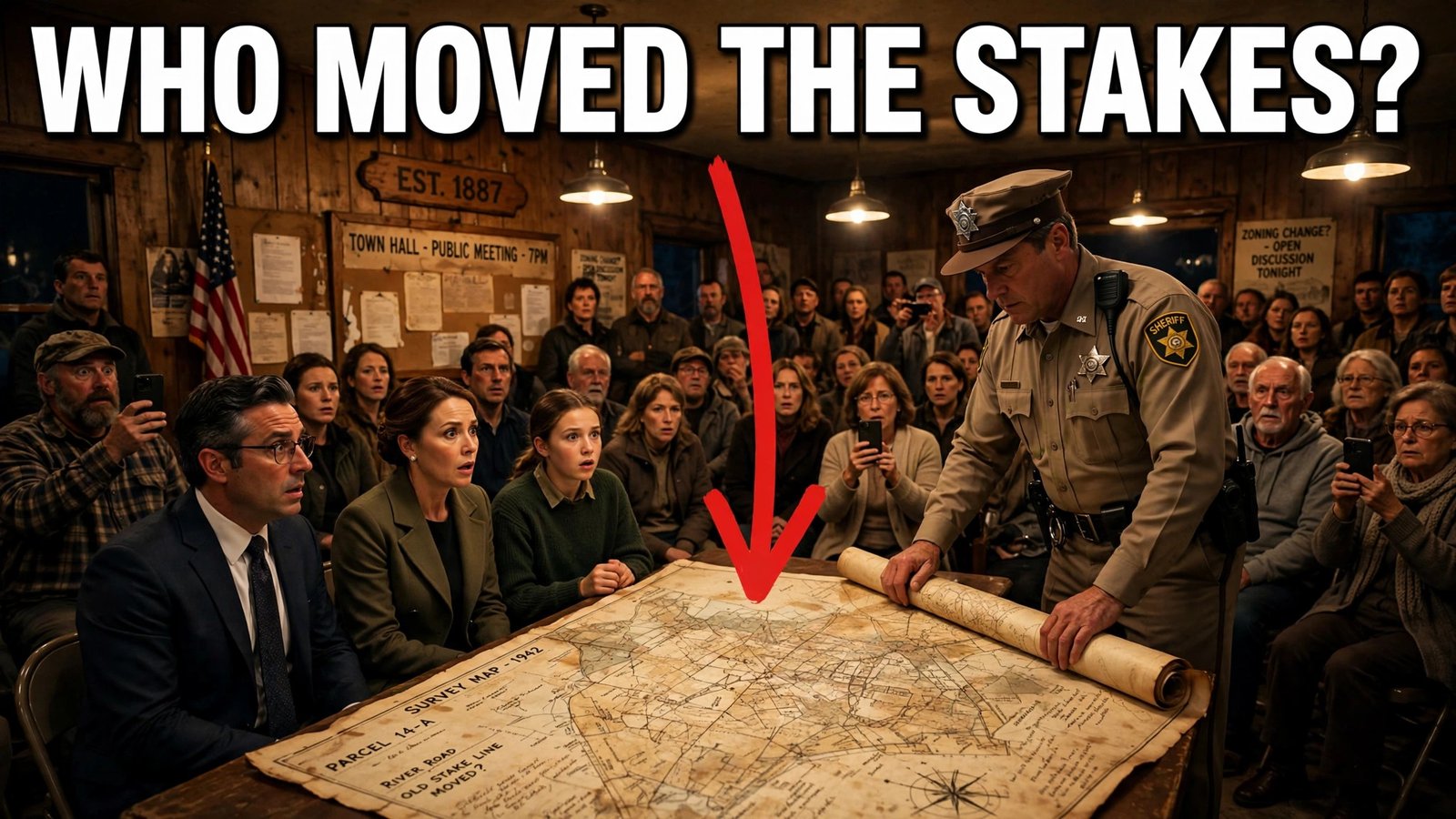
He set the leather case on the board’s table. He unzipped it. And he pulled out a map. Not a printout, not a copy, but an old survey plat on thick yellowing paper, creased along the folds, the ink faded to brown at the edges.
“This,” Cobb said, “is the original land survey for the Oak Ridge parcels. Drawn in 1924 by county surveyor Elias Ward. Filed with the county. It’s the document every deed on that road traces back to.”
He unrolled it. The paper crackled. Somebody in the back stood up to see.
“Now,” the sheriff said. “I’ve spent two days with this map, the county recorder’s records, and Mr. Bennett’s new survey. And I’m going to tell you what’s true.”
He looked at Dale Whitaker.
“Dale, you told the Bennetts their fence line was wrong. You said the property line’s been disputed for years.”
Dale shifted. “It’s common knowledge —”
“It is not,” Cobb said. “The line has never been disputed in any county record. Not once. What you remember is a fence your grandfather built in 1978, six feet onto what this map says is the Bennett parcel. Your family has been using sixteen feet of somebody else’s land for forty-eight years, Dale. And the Bennetts,” he said, looking at Darius and Lena, “the Bennetts just bought it.”
The room erupted. Chairs scraped. Somebody shouted. Dale Whitaker went white.
“That’s a lie!” Dale yelled. “That map’s a hundred years old —”
“It’s the law, Dale,” Cobb said, not raising his voice. “Deeds follow the survey. Not fences. Not memories. The survey.”
Mercer banged his gavel so hard it cracked. “Order! Sheriff, are you saying the Bennett deed is —”
“I’m saying their deed is ironclad,” Cobb said. “I’ve confirmed it with the county recorder this afternoon. Their boundary is their boundary. And a six-foot fence, sixteen inches inside it, is a permit this board has no legal grounds to deny.”
He looked around the room. At the standing people. At the phones that had come out, recording now.
“Now,” he said. “About those stakes.”
He reached into the leather case again. This time he pulled out a photograph. He held it up.
“This is a trail camera photo. Mr. Bennett put a camera on the back line after the stakes moved. Took this three nights ago at 1:14 in the morning.”
The room leaned in. Even Mercer leaned in.
Cobb smiled. It was not a warm smile.
But before he turned that photograph around, let me tell you what had happened the week before. Because the room that night didn’t know the half of it.
The Tuesday Darius found the moved stakes, he didn’t call the sheriff first. He drove to Dale Whitaker’s house. Lena begged him not to go alone, so he took her with him, and they stood on Dale’s porch at seven in the evening like civilized people and knocked.
Dale opened the door with a beer in his hand.
“Dale,” Darius said, “somebody moved the survey stakes on my west line last night. I thought you should know, since your lot borders mine.”
Dale stared at him. “Stakes move. Frost. Animals.”
“There hasn’t been frost in six months,” Darius said. “And animals don’t pull stakes up and re-drive them four feet east in a straight line.”
“You calling me a liar?”
“I’m telling you what I found,” Darius said. “I wanted you to hear it from me before I filed a report.”
Dale stepped out onto the porch. The screen door slapped shut behind him.
“Let me tell you something,” Dale said. “My granddaddy worked that ground before you were born. My daddy worked it. That fence line is where it’s always been, and no piece of paper from some city surveyor is going to tell me different.”
“Nobody’s telling you different, Dale,” Lena said. “The paper just says where the line is.”
Dale looked at her like she hadn’t spoken. He looked only at Darius.
“You people come in here,” he said, “and the first thing you do is start measuring everybody’s land. You think that’s neighborly?”
Lena’s hand found Darius’s wrist. Not pulling. Just there.
“We’re going to build our fence on our land, Dale,” Darius said quietly. “That’s all. Good night.”
They walked back to their truck. Dale stood on his porch and watched them go, and the beer can in his hand made a small crunching sound.
That was Tuesday.
On Wednesday, somebody left a note in the Bennetts’ mailbox. No stamp. No name. Just five words in block letters:
WE KNOW WHAT YOU DID.
Maya found it after school. She brought it inside without a word and set it on the kitchen counter, and Lena read it and went very still and then folded it up and put it in the folder with the deed.
“We didn’t do anything,” Jordan said. He was nine. He didn’t understand why his mother’s hands were shaking.
“I know, baby,” Lena said. “I know.”
Darius called the sheriff that night.
And now here they were. Front row. Hands folded. Waiting.
“Well,” Sheriff Cobb said again, holding the photograph, “now let’s see who our night visitor was.”
He started to turn the photograph toward the crowd.
TO BE CONTINUED.