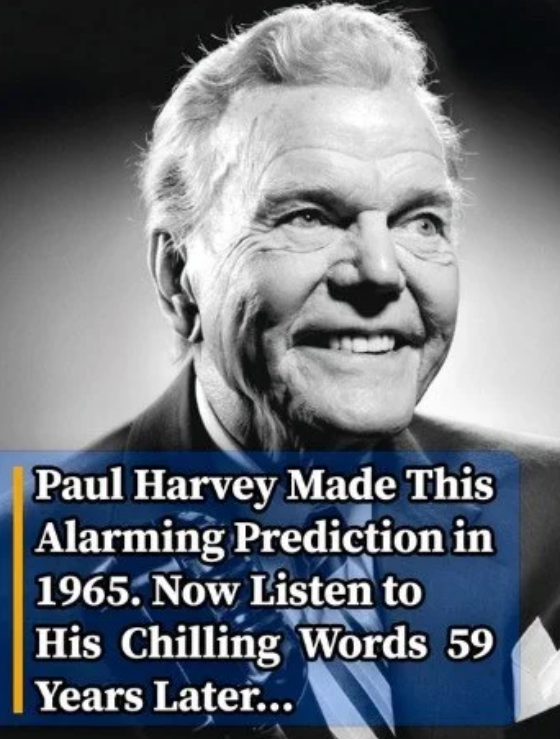
In 1965, Paul Harvey’s voice crackled through radios across America, delivering a message that felt like a punch to the gut. Known for his staccato style and razor-sharp commentary, the ABC Radio legend reached over 24 million listeners at his peak, painting vivid pictures with words that stuck like glue. But on April 3 of that year, one broadcast stood out—a haunting “what if” scenario called “If I Were the Devil.” Harvey spun a tale of societal decay, imagining himself as the Prince of Darkness plotting to unravel the fabric of the United States. Fast-forward 54 years to October 19, 2025, and his words are trending again, shared across X and YouTube with a mix of awe and unease. Why? Because so much of what he predicted feels eerily like today’s headlines. Let’s dive into this “prophecy,” unpack its uncanny parallels, and explore why it’s striking a chord now.
The Devil’s Playbook: Harvey’s Vision of Chaos
Harvey’s speech begins with a sinister premise: “If I were the Devil, I would want to engulf the whole earth in darkness.” From there, he lays out a chilling strategy to dismantle society, step by insidious step. He’d whisper to the young that “the Bible is a myth” and “man created God,” flipping morality on its head so “what is bad is good and what is good is square.” He’d glamorize excess—cocktail parties over work, drugs and alcohol as status symbols, pills to numb the rest. Schools would sharpen minds but let emotions run wild, unchecked. Courts would banish God, favoring pornography and power. Easter would become about eggs, Christmas about bottles. Ambition would be crushed, families fractured, and a police state would rise to keep everyone in line. “I’d just keep doing what I’m doing,” he concludes, “and the whole world would go to hell as sure as the Devil.”
When Harvey delivered this on his midday show, it wasn’t just radio—it was a warning shot. He saw cultural shifts brewing: the sexual revolution, rising drug use, and debates over religion’s place in public life. The 1960s were a pressure cooker—Vietnam War protests, civil rights battles, and a youth culture challenging every norm. Harvey, a conservative Christian from Tulsa, wasn’t preaching fire and brimstone; he was sounding an alarm about values slipping away. His listeners, many tuning in over lunch or in their cars, nodded along, sensing the ground shifting beneath them.
Why It Resonates in 2025: A Mirror to Our Times
Flash forward to today, and Harvey’s words feel like they were ripped from X posts or cable news tickers. Social media is ablaze with reactions, like @RetroVibes66’s viral thread: “Paul Harvey in ‘65 called it—God out of schools, families split, drugs everywhere. Look around!” A YouTube re-upload of the speech has racked up 3.2 million views since January 2025, with comments like, “This man saw 2025 from 1965. Unreal.” So, what’s fueling this revival?
- Moral and Cultural Shifts: Harvey’s talk of dismissing religion hits home for many. Since the 1963 Supreme Court ruling banning mandatory school prayer, secularism has grown—only 17% of Americans attend church weekly, down from 40% in the ‘60s, per Gallup. X users lament “God evicted from schools,” pointing to culture wars over everything from library books to gender policies. Harvey’s “bad is good” line? Some see it in debates over legalizing recreational marijuana (now legal in 24 states) or the normalization of explicit content online, where porn sites clock billions of visits yearly.
- Family and Work Breakdown: Harvey’s vision of fractured families and stifled ambition echoes today’s stats: 40% of U.S. children are born to unmarried parents, up from 7% in 1965, per the CDC. Divorce rates hover at 45%, and remote work’s rise has blurred lines between labor and leisure, with 30% of workers reporting burnout, says a 2025 Pew study. His “police state” warning feels prescient to some amid debates over surveillance tech and militarized policing, especially after high-profile incidents like the 2024 election cycle’s unrest.
- Addiction and Escapism: Harvey’s “narcotics, alcohol, pills” prediction is starkly real. The opioid crisis alone claims 100,000 lives annually, per the CDC, with fentanyl driving a 20% spike in overdoses since 2020. Alcohol consumption among women has risen 15% in a decade, and tranquilizer prescriptions are up, with 1 in 5 adults on some form of anti-anxiety med, per a 2025 NIH report. Social media’s dopamine hits, averaging 2.5 hours daily per user, feel like Harvey’s “lurid literature” on steroids.
- Polarization and Power: His talk of courts favoring power over principle resonates in a time of distrust—only 31% of Americans trust the judiciary, down from 75% in the ‘90s, per Gallup. “Our father which art in Washington” stings for those wary of centralized power, with 60% of X users in a recent poll calling government overreach a top concern. Easter eggs and Christmas bottles? Retail data shows holiday spending on decor and alcohol outpacing charitable giving 3 to 1.
A Voice That Still Echoes
Harvey wasn’t a fortune-teller; he was a keen observer, blending Midwestern pragmatism with a storyteller’s flair. His career spanned five decades, from Depression-era radio to the Reagan years, earning him the Presidential Medal of Freedom in 2005. “If I Were the Devil” wasn’t his only viral hit—his “So God Made a Farmer” speech still inspires—but it’s his most prophetic. Shared on platforms like Rumble and TikTok, it’s become a rallying cry for those feeling unmoored in 2025’s chaos: economic uncertainty (inflation hit 3.8% this year), cultural divides, and tech-driven isolation.
Not everyone buys the doom-and-gloom. Critics on X, like @SkepticVoice, argue Harvey’s speech oversimplifies: “He saw decline, but missed progress—civil rights, women’s equality, tech breakthroughs.” Others note its conservative bent ignores context: The ‘60s ushered in Medicare, voting rights, and space exploration. Yet even skeptics admit his warnings about eroded values and unchecked indulgence hold weight. A 2025 Barna study found 65% of Americans feel society lacks a “moral compass,” echoing Harvey’s fears.
Why It Matters Now
This speech isn’t just a nostalgia trip—it’s a mirror. Harvey challenges us to ask: Are we sleepwalking into his dystopia? His call to guard against whispers of “do as you please” resonates in an era of instant gratification, from same-day delivery to swipe-right culture. But it’s not all bleak. Communities are fighting back—grassroots groups pushing family values, addiction recovery programs saving lives, and schools teaching mindfulness to balance those “wild emotions.” Harvey’s devil may be busy, but so are the folks building hope.
So, give it a listen. The YouTube clip is just 3 minutes, Harvey’s voice still crisp and urgent. Share it, like thousands on X are doing, and ask yourself: What’s changed since 1965, and what can we change now? Paul Harvey didn’t just predict a storm—he handed us an umbrella. It’s up to us to open it.