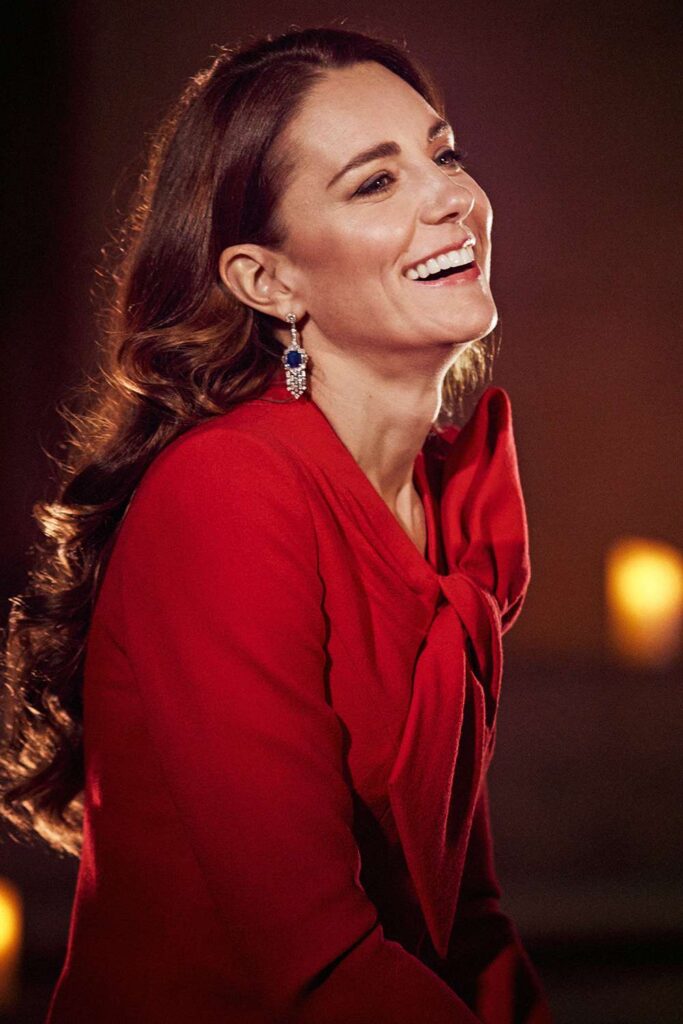
The grand ballroom of St. James’s Palace shimmered like a jewel box under the cascade of Baccarat crystal chandeliers, their light fracturing into a thousand prisms across gilded walls etched with centuries of royal whispers. It was October 28, 2025—a velvet autumn evening for the Royal Foundation’s annual gala, a beacon for families shattered by long-term illness and untimely loss. The air was thick with the scent of white lilies and beeswax candles, 300 guests—survivors, philanthropists, quiet dignitaries—in hushed conversation amid silver-domed canapés and flutes of elderflower fizz. Prince William, in a tailored navy suit, circulated with easy warmth, his hand occasionally finding Kate Middleton’s—the Princess of Wales, ethereal in a sapphire silk gown that hugged her frame like a second skin, her low chignon framing a face luminous with quiet resolve. Post-chemotherapy, her glow was no longer effortless, but earned—each smile a victory over the shadows of 2024’s diagnosis.
The evening’s centerpiece: a string quartet from the Royal College of Music, their bows drawing sighs from Vivaldi. But as the final “Winter” Largo faded, the room stilled further. Kate rose from her seat beside Camilla, who squeezed her hand with maternal firmness. No announcement. No fanfare. She crossed the polished parquet floor—heels muted by Persian rugs—toward the ebony grand piano at the hall’s heart. The quartet parted like courtiers. William’s eyes followed, pride flickering amid the ever-present vigilance. Guests leaned in: a Macmillan nurse mid-sentence, a bereaved father pausing his wine. Kate sat, fingers hovering over keys like a surgeon’s scalpel—delicate, deliberate. She exhaled. And played.
The first notes of Schubert’s “Ave Maria” unfurled—soft as snowfall, crystalline as dawn on the Thames. Not a virtuoso cascade, but a prayer: measured, meditative, each chord laced with the vulnerability of one who knew illness’s ache intimately. The room—once a murmur of clinking crystal—fell into profound silence. Candle flames danced in draftless hush; a diplomat’s glass paused mid-lift. Kate’s hands moved with the grace of her ballerina youth—poise unbroken by treatments, fingers tracing melodies she’d practiced in Kensington’s solitude, late nights when chemo’s fog lifted just enough for music to mend.
Then, from the shadowed alcove beyond the piano—where tapestries of Henry VIII loomed like benevolent ghosts—emerged Andrea Bocelli. The 67-year-old tenor, sightless yet unerringly present, glided forward in midnight velvet, his cane tucked discreetly aside by an aide. No spotlight chase. No orchestral swell. Just a man, drawn by the notes like a moth to flame. Kate’s eyes met his—unseen by him, but felt—and her playing steadied, inviting. Bocelli placed a hand on the piano’s curve, as if greeting an old friend, and opened his mouth.
His voice ascended—“Ave Maria, gratia plena…”—a golden arc soaring from baritone depths to tenor heights, rich as Tuscan earth, ethereal as vespers in Siena’s Duomo. It wasn’t accompaniment; it was communion. Kate’s piano wove beneath: arpeggios like whispered Ave’s, sustaining the tenor’s flight without overpowering, a duet unspoken yet seamless. The hall transformed—chandeliers dimmed in collective breath, guests transfixed: a young widow clutching her program, tears tracing silent paths; William’s jaw set, hand to heart, memories of his mother’s charity anthems flickering. Camilla dabbed her eyes with a lace handkerchief; even stoic courtiers shifted, throats tight.
Bocelli’s phrasing—haunting, honed by decades of Sacred Arias and papal masses—interlaced with Kate’s restraint, her chords grounding his celestial rise. Midway, he paused—not for breath, but reverence—his hand lifting from the piano. “Music doesn’t heal the wound,” he murmured, voice a velvet rumble carrying to every corner, “but it holds your hand while you heal.” The words, improvised, landed like grace notes. Kate’s fingers faltered a beat—emotion rippling—then resumed, stronger, the “Dominus tecum” blooming in harmonic prayer. Guests wept openly now: a Macmillan CEO, who’d lost her sister to cancer; a father, his son’s photo pinned to his lapel. The foundation’s cause—support for the bereaved—pulsed alive in every vibration.
As the final “Sancta Maria, Mater Dei…” dissolved into silence, the room exhaled. Then rose—a standing ovation not thunderous, but tidal: waves of applause building from front-row sniffles to rear-rank roars. Kate stood, bowing her head—not to acclaim, but to the invisible threads binding the crowd. Bocelli enveloped her in a gentle embrace, whispering in Italian—“Grazie, principessa. Hai toccato l’anima”—before turning to the hall: “For every hand held in darkness, this light endures.”
A Gala of Grace: From Shadows to Symphony
The evening was no serendipity. The Royal Foundation gala—£2 million raised for early-cancer detection and grief counseling—marked Kate’s first major public post-treatment appearance since March 2024’s diagnosis reveal. Bocelli’s invitation? Hers—his Sacred Arias a chemotherapy companion, played on loop during hospital vigils. Rehearsal? None. “Music finds its way,” she’d told William over breakfast at Adelaide Cottage. The piano? A Steinway once played by Chopin for Queen Victoria—history harmonizing with heart.
Guests: 300 souls of quiet influence—Sir David Attenborough sharing warbles with young George; J.K. Rowling toasting “stories that heal”; veterans from the recent MoD funding win, their medals glinting like stars. Camilla hosted, her warmth a counterpoint to protocol; Harry, in from California, shared a rare laugh with William over old polo scrapes. But Kate’s moment? The axis. Her gown—McQueen, sapphire like Diana’s ring on her finger—symbolized continuity: the “People’s Princess” ethos alive in quiet keys.
Insiders reveal: Kate’s playing, honed at Marlborough College, had gathered dust amid motherhood and monarchy. Cancer reignited it—a therapy for trembling hands, a bridge to normalcy. Bocelli, who’d performed for Diana’s funeral (Candle in the Wind), saw echoes: “Catherine carries her compassion—like a melody unbroken.”
Whispers in the Wings: A Princess’s Private Prelude
Backstage whispers paint the prelude. Kate, post-op glow fading into fatigue, confided in Sophie Wessex: “Music’s my anchor—holds when words fail.” Bocelli, arriving from Tuscany, embraced her: “Your grace is the greatest aria.” No score—Kate improvised around Schubert’s theme, Bocelli weaving vocally. The pause? Spontaneous—his words, a mantra from his own blindness battles, landing like revelation.
William later: “She played for us all—for the families fighting silent wars.” George, 12, told aides: “Mummy’s music makes the sad go quiet.”
The World Echoes: 200 Million Views, A Melody’s Mending
By 10:00 PM, a Palace-approved clip—Kate’s first notes to final bow—hit Instagram. Dawn: 200 million views. #KateAndBocelli trended No. 1 global, outstripping US elections. TikToks layered the duet with Diana’s hugs: “From AIDS wards to aria—legacy in lace.” X:
- Andrea Bocelli: “A princess with a pianist’s soul. Honored to harmonize. #AveMariaForHope” (18M likes)
- Prince William: “Catherine’s gift tonight—music that mends. Proud beyond words.”
- Elton John: “Di would adore this. Pure, poignant. Bravo.”
The Times: “A stoic spouse, a sacred sound—Kate’s keys unlock the Firm’s heart.” Streams of Ave Maria surged 800%; a duet single drops December 1, proceeds to East Anglia’s Children’s Hospices—Diana’s cause.
Survivors shared: A mother, chemo-fresh: “Her hands held mine through the notes.” The gala raised £3.2 million—record, fueled by the moment’s magic.
Grace in the Keys: A Princess’s Prayer
As the evening waned, Kate and Bocelli lingered by the piano. “You healed us,” he said. She smiled: “We healed together.” William joined, arm around her waist; the trio posed for one last photo—smiles soft, eyes shining.
In St. James’s shadows, where queens danced and kings decreed, Kate’s Ave Maria wasn’t spectacle. It was sacrament: fingers on ivory, voice in void, a princess playing for the fragile. And in that hush, grace met grace—reminding a fractured world: When words fail, music holds. Forever.