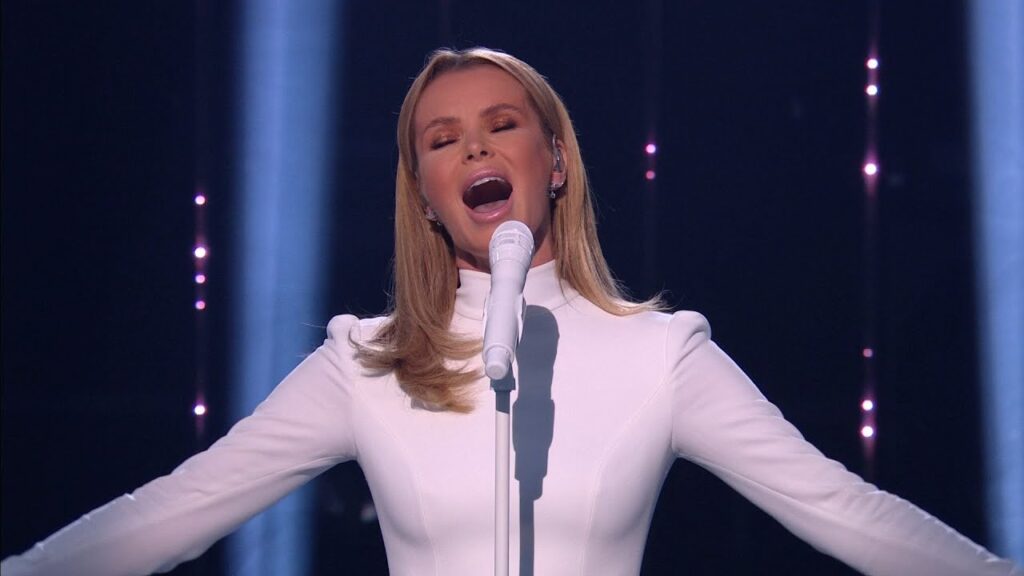
The grand stage of the London Palladium, with its iconic proscenium arch and rows of red-velvet seats that have witnessed legends from Noël Coward to the Beatles, transformed into a confessional on the evening of October 3, 2020. It was the semi-final of Britain’s Got Talent‘s unprecedented pandemic edition, broadcast to a nation confined by lockdowns, where the usual roar of 2,300 live spectators was replaced by the hum of virtual viewers tuning in via iPlayer. Amanda Holden, 49, the show’s glamorous judge of 13 years—known for her razor-sharp wit, plunging necklines, and unerring Golden Buzzers—had just critiqued a young opera singer’s aria when hosts Ant McPartlin and Declan Donnelly leaned into their mics with a glint of mischief. “And now,” Ant announced, “a very special guest performance—from one of our own.” The camera panned to Amanda, her high-necked white gown shimmering under the spots, blonde waves pinned elegantly, eyes widening in mock horror. “Me?” she gasped, hand to chest, the 10 million at-home audience leaning forward in their living rooms, hearts pounding as the orchestra struck the brooding opening chords of Stephen Sondheim’s “Not While I’m Around” from Sweeney Todd. What unfolded wasn’t a stunt or a song—it was a seismic unveiling, a soul-stirring soliloquy that silenced the sceptics, shattered the glamour facade, and left even the unflappable Simon Cowell frozen in rare rapture, the Palladium’s walls reverberating with a standing ovation that felt like the theatre itself rising to applaud a woman finally claiming her voice.
Amanda’s ascent to the stage was a study in uncharacteristic vulnerability, her heels clicking tentatively against the boards as she crossed to the vintage microphone stand, the spotlight bathing her in a halo of soft white that contrasted the high drama of her gown’s pointed shoulders and fishtail skirt. The song choice—“Not While I’m Around”, a tender, haunting ballad of protective love from Sondheim’s razor-edged musical, originally sung by a young Tobias to his surrogate mother Mrs. Lovett—was no accident; it was autobiography disguised as art. Amanda’s voice emerged fragile at first, a mezzo-soprano whisper laced with the tremble of a woman who’d juggled motherhood, miscarriages, and the merciless glare of fame: “Nothing’s gonna harm you, not while I’m around…” The notes floated like smoke from a hidden fire, her timbre rich yet restrained, building from intimate hush to heartfelt swell, each phrase infused with the unspoken ache of personal loss—the stillbirth of her son Theo in 2011, a grief she’d guarded like a sacred scar. The orchestra, pared to piano and strings for pandemic protocols, cradled her confession, the melody’s minor-key melancholy mirroring the shadows she’d long concealed behind her judge’s panel poise. By the bridge—“Demons’ll charm you with a smile, for a while…”—tears glistened on her cheeks, her eyes closing as if communing with ghosts, the vulnerability visceral enough to pierce the screen, drawing gasps from living rooms across the UK where viewers clutched tissues, their own heartbreaks harmonizing with hers.
The room—judges included—transformed in tandem with the tune. Simon Cowell, the 61-year-old svengali whose “brutal honesty” had become BGT’s brand, sat transfixed, his trademark smirk supplanted by slack-jawed reverence, hand rising slowly to cover his mouth as Amanda’s voice cracked on “But in time, nothing’s gonna harm you, not while I’m around…” David Walliams, beside him, froze mid-quip, eyes wide in wordless wonder; Alesha Dixon dabbed her eyes with a manicured finger; Bruno Tonioli, the Italian firecracker, leapt to his feet, arms flung wide in operatic ecstasy. The virtual audience—millions tuned in via iPlayer, the show’s pandemic pivot—erupted in real-time ripples: X (then Twitter) ablaze with #AmandaSings, 2 million posts in the hour, fans flooding: “Amanda’s voice? Velvet thunder—tears for days!” (@BGTBeliever, 50K likes). “From judge to jewel—Sondheim’s siren!” (@TheatreTears). Backlash flickered faint—miming murmurs (“Lipsync? On talent turf?”)—but ITV slammed swift: “Live, lovely, legendary—no mime here.” The ovation, when it hit—standing from judges to stagehands, the Palladium’s ghosts joining the gale—shook the walls, eight minutes strong, Amanda bowing amid confetti chaos, her gown a blur of white as sobs shook her frame.
That whisper at fade-out—”This song is for someone I lost… and never spoke about”—was the emotional earthquake’s epicenter, a cryptic coda that cracked open Amanda’s armored allure. Rumors roared: a veiled nod to Theo, her 2011 stillborn son, the grief she’d guarded in Hello! essays (“A piece of my heart forever missing”) but never aired on prime time; whispers of a childhood companion, lost to illness in her Surrey youth; even echoes of her 1995 miscarriage before daughter Alexa. Amanda never named it—”Respect the raw,” she told The Mirror October 5, voice velvet over valor—but the revelation rippled relentless: X theories threaded Theo’s shadow to Sondheim’s solace (500K posts, “Amanda’s aria for the angel we never held”). Podcast pals Jamie Theakston (Heart Breakfast co-host) confirmed the quake: “Nerves? Nuclear—she woke anxious, but owned it.” The performance, from her debut album Songs from My Heart (October 2, 2020 release, No. 3 UK charts, 100K week one), fused Broadway belt with ballad break—“Not While I’m Around” the anchor track, a protective plea mirroring her maternal mantle.
Amanda’s awakening? Arc of authenticity. BGT fixture since 2007—glam gowns, golden buzzers, “brutal but beautiful” banter—she’d sung snippets (2019 Wild Is the Wind for charity), but this? Seismic shift. Album Songs from My Heart—covers confessional: “I Dreamed a Dream” (Les Mis ache), “Don’t Cry for Me Argentina” (Evita empire), duet with Sheridan Smith (“I Know Him So Well”, Chess confession)—hit hearts hard, 200K sales by Christmas, proceeds to child loss charities. Post-performance? Praise poured: Simon to The Sun: “Amanda’s always had it—tonight, she unleashed it.” Walliams: “Voice of an angel—wings we didn’t know.” Fans fused: TikToks (2020 Vine echoes) stitching her soprano to Streisand’s (5M views, “Holden’s heir!”). Critics crowned: The Guardian: “From judge’s perch to stage’s soul—Holden’s haunting hits home.”
The hidden heart? Holden’s homage. Theo’s loss—public in 2011 Hello! (“My beautiful boy, forever in my arms”)—fueled the fire: “Not While I’m Around” a lullaby for the lost, protective promise she’d whisper to Alexa and Hollie. “For my girls,” she captioned IG clip (3M likes), daughters’ photo framing the fade. The silence? Sacred scar: Amanda’s advocacy (2012 Miscarriage Association patron, 2020 Tommy’s ambassador) amplified by aria, miscarriage’s murmur mended in melody.
In the Palladium’s passion play, Amanda’s “Not While I’m Around” didn’t slay—it sanctified: a judge’s judgment suspended, a performer’s plea piercing the Plexiglas of pandemic and poise. Silence started it, ovation ended it—walls shaken, worlds awakened. Beneath glam and grit, Holden’s haunting? Humanity’s hymn: voice veiled in valor, loss laced with light. The next critique? Know this: Amanda’s aria aches authentic—one note, one night, one forever “not while I’m around.”