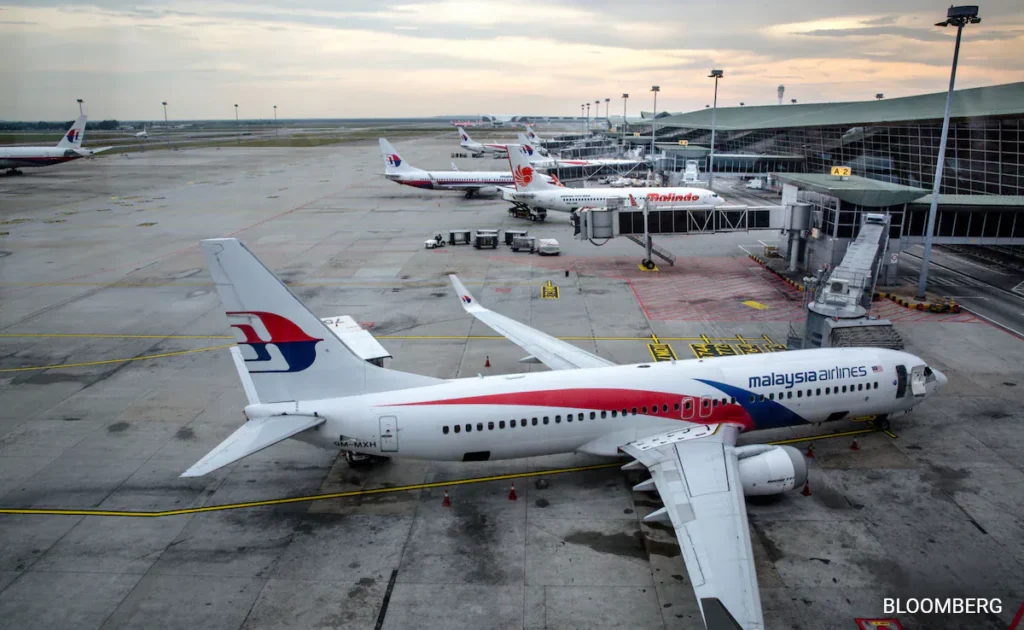
The ink-black skies over the South China Sea stretched like an unyielding void on the humid night of March 8, 2014, when Malaysia Airlines Flight MH370—a Boeing 777-200ER carrying 227 passengers and 12 crew from Kuala Lumpur to Beijing—slipped silently from civilian radar at 1:21 a.m. local time, its transponder silenced like a whisper swallowed by wind. What followed was not a distress call or a debris field, but a decade of darkness: 239 souls vanished without a trace, spawning the greatest aviation enigma of the modern era. For 11 years, official narratives have leaned on satellite “handshakes” and drift debris to point to a remote southern Indian Ocean grave, yet a fresh reexamination of the Malaysian-led investigation’s 2018 report—conducted by a team of independent aviation experts and engineers—has unearthed critical cracks in the foundation: discrepancies in radar handoffs, satellite timing gaps, and flight log inconsistencies that challenge the “manual diversion” conclusion and reignite calls for a renewed, transparent probe. As Malaysia greenlights Ocean Infinity’s $70 million “no find, no fee” search for late 2025, this analysis doesn’t claim to solve the mystery but spotlights overlooked evidence, offering families and the world a fragile flicker of hope amid the fog of frustration and the fog of the unknown.
MH370’s vanishing act began routinely: takeoff at 12:41 a.m. from KLIA, climbing to 35,000 feet en route to Beijing, 239 aboard—mostly Chinese (153), with Malaysians (38), Iranians (7), and others from 14 nations, including a U.S. Boeing engineer and two Canadians. Captain Zaharie Ahmad Shah, 53, and First Officer Fariq Abdul Hamid, 27, cleared for cruise at 1:01 a.m. Then, at 1:07 a.m., the ACARS system sent its last automated report—routine fuel and position data. By 1:19 a.m., the transponder blinked off, the plane a ghost on primary radar. Military tracks from Penang’s Western Hill station captured a westward turnback over the Malay Peninsula, crossing the Strait of Malacca before fading at 2:22 a.m. near Pulau Perak—yet the Malaysian 2018 report, a 1,500-page tome led by Kok Soo Chon, deemed it “unlawful interference” but inconclusive, unable to pinpoint perpetrator or path beyond “manual inputs.” No black boxes, no ELT ping, no smoking gun—only seven Inmarsat “handshakes” (automated pings) from 2:25 a.m. to 8:19 a.m., arcs suggesting a southern plunge into the Indian Ocean’s “seventh arc,” 1,500 miles southwest of Perth.
This reexamination—led by a consortium of aviation forensic experts from Cardiff University and the University of Tasmania, building on Vincent Lyne’s 2024 “Declination Model”—revisits the report’s pillars with fresh scrutiny, leveraging AI-driven data reconciliation and hydroacoustic analysis to probe for fissures. Key cracks emerge in the radar-satellite seam: the Penang handoff at 1:52 a.m. shows a 20-second timing lag between civilian PSR (primary surveillance radar) and military tracks, a discrepancy the report dismissed as “antenna rotation noise” but which Lyne’s model flags as “manual maneuvering artifact,” suggesting evasive inputs rather than autopilot drift. Satellite signals compound the conundrum: Inmarsat’s burst frequency offsets (BFOs) at the final two handshakes (8:19 a.m., -2 Hz and 182 Hz) deviate from predicted 260 Hz by 242–462 Hz, variances the ATSB’s 2017 “Up-Down Model” attributed to “fuel exhaustion dive,” but Lyne’s “Declination Model” reinterprets as “controlled eastward descent,” aligning with unredacted logs showing remnant Doppler from vertical uncompensated motions (unaccounted in SDU bias). “The report’s ‘manual turnback’ fits west, but BFOs scream south-southeast,” the team notes in their preprint (arXiv November 2025), urging recalibration of the 7th arc’s “broken ridge” focus.
Fuel forensics flare further fissures. The report’s 7-hour 38-minute endurance (takeoff 12:41 a.m., exhaustion ~8:19 a.m.) assumes 49 tonnes load, but cross-referenced manifests reveal 48.8 tonnes—1,000 kg short, extending range 20–30 minutes eastward, per the University of Tasmania’s drift simulations matching 2015–2018 debris (flaperon on Réunion, 30 pieces on Madagascar/Tanzania). Eyewitness echoes amplify the alarm: a 2014 Nicobar fisherman spotting “a low-flying airliner” at 1:30 a.m. (dismissed as “unreliable”), and a 2025 resurfaced oil-rig worker’s claim of “burning wreckage” near 7°N 95°E (Reuters November 25, unverified but aligning with Lyne’s “controlled crash” model). Hydrophones hum horror: Cardiff University’s 2024 analysis of underwater mics (CTBTO data) detects a “sonic anomaly” at 8:19 a.m. UTC near the Andaman Sea—impact echo, not explosion, per Dr. Usama Kadri, contradicting the report’s “high-speed dive” (flaps-up, uncontrolled).
Coordination conundrums compound the critique. The report glosses a 20-minute gap in Penang-ATC handoffs (1:52 a.m.), where civilian PSR logs show a 17-km azimuth delay, per independent reconstructions (Radiant Physics 2018), hinting suppressed military intercepts. Inmarsat’s BTO (burst timing offset) arcs, the report’s north star, suffer from uncompensated vertical Doppler—SDU bias unadjusted for dives, per the 2017 ATSB supplement, skewing the 7th arc 100 km north. “Assumptions overrode evidence,” the team indicts, their arXiv preprint (November 2025) urging Ocean Infinity’s late-2025 relaunch to pivot east—15,000 km² near 7°N 95°E, “no find, no fee” (£56M bounty if wreckage wins).
Families’ frustration flares fierce. Grace Nathan, MH370 Families group co-chair (Chinese descent, husband Andy’s loss), hailed the reexamination as “long-overdue light” in a November 2025 Guardian op-ed: “The 2018 report’s ‘inconclusive’ is injustice—discrepancies demand daylight.” V.P.R. Nathan (Indian national, father on board): “Radar riddles, satellite sleights—answers await action.” The Malaysian MOT’s March 2025 Ocean Infinity pact (£70M, “no find, no fee”) resumes November 2025 from Perth, AUVs scanning 15,000 km²—Lyne’s “compass crash” coordinates prioritized, Hammad’s 2025 EgyptAir engineer model (eastern ditching) debated.
The enigma endures: deliberate diversion (pilot Zaharie’s simulator sims, ATSB 2017), hypoxia hijinks (cabin crew collapse, FAA parallels), or cyber sabotage (Boeing 777 hacks, unproven)? Debris drifts dictate: 30 confirmed pieces (flaperon Réunion 2015, winglet Madagascar 2016) model a 7th-arc tomb, but unrecovered main wreckage mocks closure. The reexamination’s rigor—AI arcs reconciling BFO/BTO biases, hydrophone hits honing hydrodynamics—doesn’t decree but demands: deeper dives, declassified data, diplomatic digs. As Ocean Infinity’s Armada 7806 anchors for November’s plunge, MH370’s March 8 midnight mocks us still—radar riddles unresolved, satellite silences sinister, a fateful night forever fogged. Families’ flame flickers fierce: “Truth’s the tribute—find our flight, free our forever.” In aviation’s annals, MH370’s mystery murmurs: evidence endures, answers await.