CHAPTER 1 – THE QUIET ONE
“Empty your pockets, Private.”
Sergeant Daniels said it loud. He said it for the whole bay.
Forty bunks. Forty men in PT shirts standing at attention in the aisle. And me, standing in the middle of it all with my hands at my sides and my jaw shut the way it had been shut since I got to Fort Carver three weeks ago.
Corporal Nguyen’s watch was gone. A good one: the kind you buy before a deployment because you want to come home and still have it. It had been in his wall locker. The lock was cut.
“Private Cole,” Daniels said. “I won’t say it again.”
I emptied my pockets. Lint. A folded bus ticket stub I couldn’t throw away. A stick of gum, chewed flat, that I kept forgetting to get rid of.
Nothing else.
“Wall locker,” Daniels said. “Open it.”
The whole platoon watched me walk to my locker. I could feel it: that specific silence that happens when forty guys have already decided you’re guilty and they’re just waiting for the proof.
I turned the combination. Swung the door wide.
Uniforms. Boots lined up heel-toe. A Bible with a cracked spine. A framed photo face-down on the top shelf. I kept it that way so nobody would ask.
Daniels went through it himself. Patted every pocket. Shook every boot. Opened the Bible and fanned the pages like he expected a stack of stolen cash to fall out.
Nothing.
“Under the mattress,” someone muttered from the back. Private Lawson. He’d lost twenty bucks two weeks ago and he’d been gunning for me ever since.
Daniels stripped my bunk. Mattress flipped. Pillow torn open. He even ran his hand along the bed frame rails.
Nothing.
The sergeant stood there for a long moment, staring at my wrecked bunk, and I saw something cross his face that wasn’t anger. It was embarrassment. He’d been sure.
“Platoon, dismissed,” he said finally. “Cole, square this away.”
They filed out. Nobody looked at me. That’s how it goes when you’re the suspect and the search comes up empty. Nobody apologizes; they just move the suspicion somewhere quieter.
Lawson stopped in the doorway. “Lucky,” he said.
I didn’t answer. I never answered. That was the problem, I guess. A man who doesn’t defend himself looks like a man with something to hide.
I remade my bunk the way the manual says, hospital corners, blanket folded to a six-inch cuff, and put the Bible back. Picked up the face-down photo and stood there holding it for a minute.
The photo showed a woman and a boy on a porch. The woman was my mother. The boy was me, age nine, holding a fishing rod almost as tall as I was.
My mother had died in March. Cancer. Fast and unfair, the way it always is.
The bus ticket stub in my pocket was from the trip to her funeral. The Army gave me four days. I buried her on a Tuesday and was back in formation Friday morning.
Nobody in the platoon knew that. I hadn’t told anyone. Some grief you don’t share with forty strangers who already think you’re a thief.
I set the photo back down, face-down, and went to chow.
That was Tuesday. The watch was the fourth thing to go missing in three weeks.
First it was Lawson’s twenty dollars. Then a set of dog tags from Private Okafor’s footlocker. Then a silver bracelet that belonged to Specialist Ruiz, his daughter’s hospital bracelet from when she was born, the thing he carried on every deployment.
The bracelet was the one that broke the platoon. You can laugh off twenty bucks. You don’t laugh off a man’s daughter.
And every time, the same whispers. Cole’s locker was closest to the door. Cole never talked. Cole showed up with nothing: one duffel bag, no car, no family calling on Sundays.
Quiet guys are always the suspects. It’s practically a rule.
What nobody knew, what I never told a soul, was that I’d been watching. Not the way they thought. I’d been watching the way a hunter watches a trail.
Because I’d figured out something on my very first week, lying awake at 2 a.m. listening to the barracks breathe.
The thief never hit during the day. Never during duty hours. The hits happened between 0100 and 0300, always on nights when a certain bunk was empty.
Bunk 34. Private First Class Derek Vane.
Vane was the platoon golden boy. Squad leader’s favorite. PT stud, sharp uniform, the guy who led the cadence on runs and high-fived the drill sergeants like they were his uncles. Nobody suspected Vane. Nobody ever suspects the golden boy.
But I’d noticed. On the night Lawson’s twenty went missing, Vane had signed out for a “library run” at 0130 and come back at 0245. On the night of the dog tags, Vane’s bunk was empty during the 0200 fire watch round, and his battle buddy said he was “in the latrine” for forty minutes.
Forty minutes in the latrine at 2 a.m. Sure.
And the bracelet: the night Ruiz’s bracelet vanished, I’d woken up to the sound of a wall locker clicking shut. I’d opened my eyes just enough to see a shape moving past the foot of my bunk. Tall. Left-handed. The locker had been opened with the left hand; I could tell by the angle of the shadow on the wall.
Vane was left-handed. The only left-hander in the bay.
I never said a word. Because suspicion isn’t proof, and in the Army, accusing the golden boy without proof is how a private ends his career before it starts.
So I did what quiet guys do. I waited. I watched. And I set a trap.
Wednesday night, after lights-out, I did something I hadn’t done since I got here. I talked.
“Ruiz,” I whispered across the dark bay. “You still got that spare bracelet? The fake one?”
A long pause. Then: “Yeah. Why?”
“Put it in your locker tomorrow. Tell nobody.”
“Why?”
“Because I’m going to catch him,” I said. “And I need bait.”
Silence. Then Ruiz’s voice, different, hopeful and scared at the same time. “You know who it is.”
“I know who it isn’t,” I said. “It’s not me. And after tomorrow night, everyone else will know that too.”
Thursday crawled. I did everything normal. PT at 0530. Chow. Motor pool duty, sweeping a floor that didn’t need sweeping. I laughed at Lawson’s jokes. I let Vane slap my shoulder and call me “the ghost,” his nickname for me, because I never talked.
At 2100, Ruiz put the spare bracelet in his wall locker, right on top where anyone casing the lockers would see it. A cheap metal band, shiny enough to look valuable in the dark.
At 2200, lights out.
I lay in my bunk with my eyes open, staring at the ceiling pipes, counting the sounds. Snores. A cough. Someone’s phone buzzing under a pillow three bunks down.
At 0047, I heard it. The soft click of the bay door.
I didn’t move. I breathed slow, the way you breathe when you’re asleep.
Footsteps. Bare feet on tile, careful. Moving down the center aisle. Stopping at Ruiz’s locker, bunk 12, three down from mine.
The sound of a lock being worked. Not cut this time. Picked. Whoever it was had gotten better, or bolder.
The locker door swung open with the softest sigh of hinges.
I sat up.
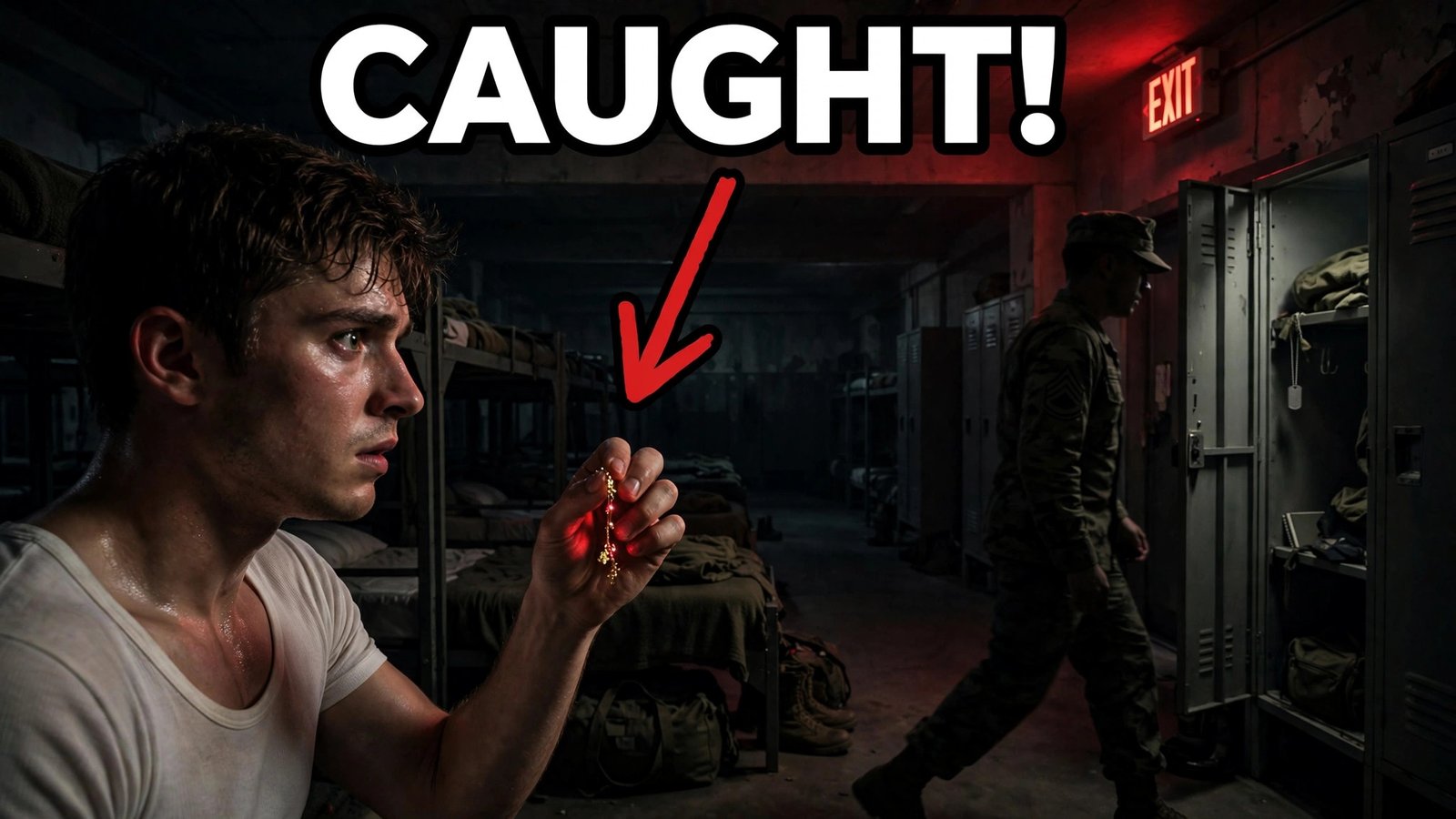
And I saw him, backlit by the red glow of the exit sign, one hand inside Ruiz’s locker, the bracelet glinting between his fingers.
I swung my legs over the side of my bunk and stood up, and my voice came out of the dark like a gunshot.
“Got you.”
He spun. The bracelet hit the tile with a sound like a dropped coin.
It wasn’t Vane.
It was Sergeant Daniels.
My blood went cold and then hot, because my brain was doing the math faster than my mouth could move: the sergeant, the man who’d searched my locker in front of everyone, the man who’d pointed the whole platoon at me.
“Private,” Daniels said quietly. “Get back in your bunk.”
“Sir,” I said, “no.”
Behind me, bunks were creaking. Guys sitting up. Someone whispered, “What the hell—”
Daniels took a step toward me. In the red exit-sign glow, his face looked carved out of something hard.
“You don’t understand what you’re seeing,” he said.
“Then explain it,” I said. “Because from where I’m standing, I’m watching my sergeant steal from his own soldiers.”
“COLE.” The voice cracked like a whip. “Bunk. Now. That’s an order.”
And I stood there in my underwear in the middle of the bay at 1 a.m., forty guys watching, with the proof of three weeks of theft lying on the tile between us. And I realized I had about five seconds to decide what kind of soldier I was going to be.
I bent down and picked up the bracelet.
“Sir,” I said, holding it up so everyone could see. “I think the platoon deserves to know where the other things went. The watch. The twenty dollars. The dog tags.”
Daniels’s jaw worked. For a second I thought he was going to charge me.
Then the bay door clicked again.
And a second voice came out of the dark behind me, close, right at my shoulder, and said:
“Put it down, Private. Slowly.”
I turned.
PFC Derek Vane was standing there in the dark with a combination lock in his left hand and the saddest smile I’d ever seen on a man’s face.
And behind Vane, half-hidden in the doorway, was Specialist Ruiz, holding his phone up, recording everything.
The trap had worked. Just not the way I’d planned it.
Because Vane wasn’t the thief.
Vane was the lookout.
And the look on his face told me the real question wasn’t what Daniels had stolen.
It was what Daniels had on Vane that made the golden boy stand watch while his sergeant robbed his own men.