CHAPTER 1 – THE EULOGY
“That man never served a single day.”
Reverend Marcus Cole didn’t mean to say it out loud.
The words slipped past his lips before his brain could catch them, and the widow, sitting three feet away with a folded flag on her lap, went still.
The stranger in dress blues never stopped talking.
He stood at the front of Riverside Chapel, hands clasped behind his back, voice breaking on every other word as he talked about Danny Reyes. Not the Danny everyone here knew. A different Danny. The one who used to cry on night watch. The one who wrote letters home to a girl named Rosa and never mailed them.
“He kept a photo of his mother’s hands in his helmet,” the stranger said, staring down at the closed casket. “He said hands like hers built everything worth saving.”
Marcus felt the hair rise on the back of his neck.
That detail had never been in the official bio. Never in a single news story. Marcus had sat with Rosa for three hours yesterday preparing the service, and she’d never mentioned a photo in a helmet.
So how did a stranger know?
The man in dress blues wiped his eyes with the back of his hand (wrong hand, Marcus noted; every soldier alive wipes with the right) and stepped down from the podium. He placed his palm flat on the casket lid, bowed his head, and whispered something nobody could hear.
Then the ushers came, and the casket rolled toward the doors, and the stranger walked beside it like he had every right in the world.
Marcus followed. Because something was eating him, and he’d learned in twelve years of military chaplaincy to trust that gnawing feeling the way sailors trust a barometer.
Outside, under the flat October sky, the honor guard waited by the grave. Taps hadn’t been played yet. The folded flag hadn’t been presented. Protocol had about forty minutes of ceremony left.
The stranger in dress blues stood in the front row, reserved for family.
Marcus leaned toward the funeral director. “Do you know him?”
“Never seen him before today. Showed up at the viewing last night. Told the staff he was Danny’s brother.”
“He doesn’t have a brother.”
The director blinked. “Rosa said—”
“Rosa said Danny had a sister in Tucson.” Marcus had checked. He always checked.
The stranger caught Marcus watching him.
He didn’t look away. He nodded once, slow, the way men do when they’re carrying something heavy and they’ve decided to let you see it.
And that’s when Marcus’s eyes dropped to the uniform.
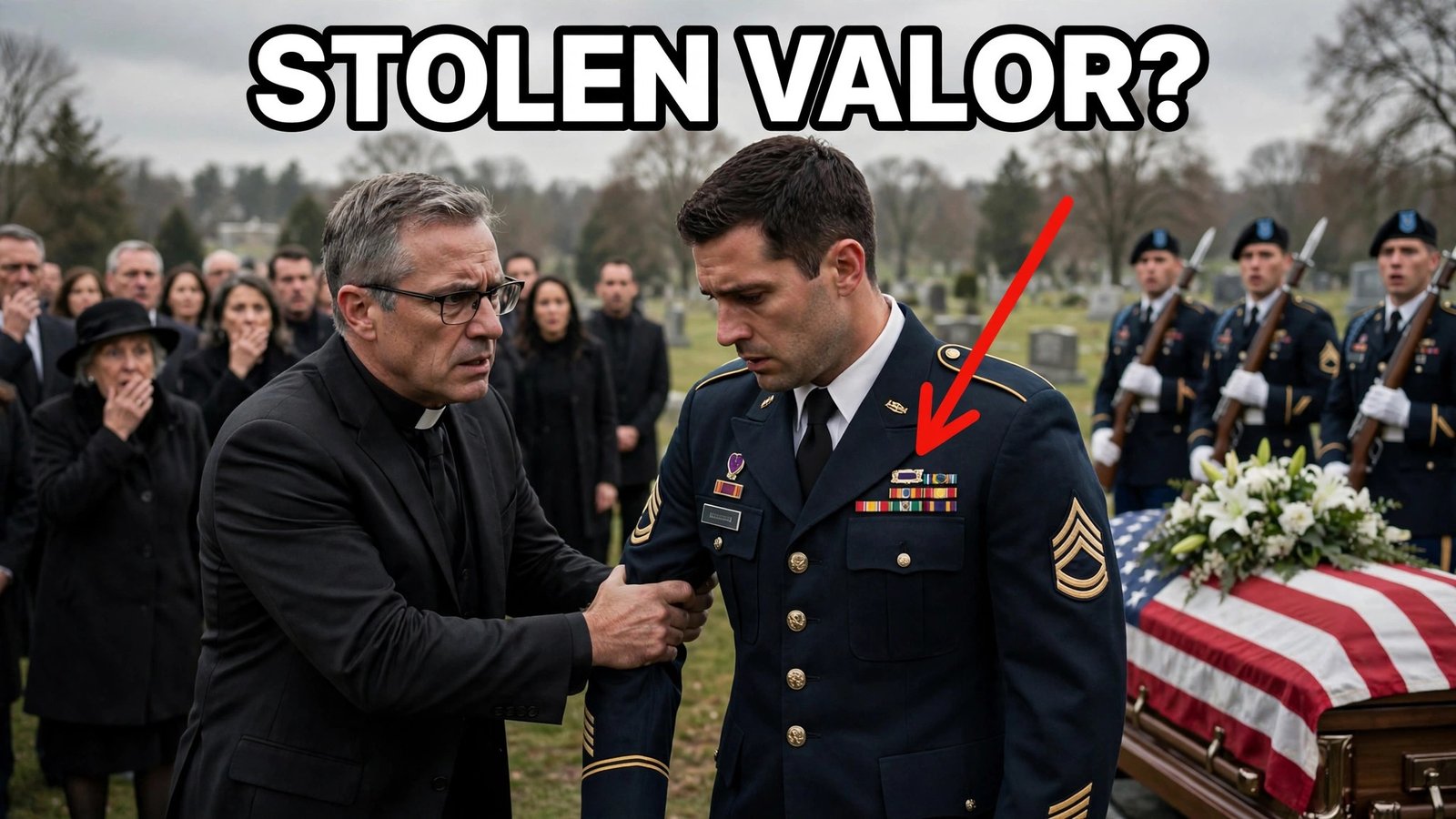
Army Service Uniform. Dress blues. Impeccable cut, mirror-shine shoes, brass like firelight. But the left breast, the ribbon rack, was wrong in a way that made Marcus’s stomach drop.
Two rows. Six ribbons. And the top row, center slot, the place of honor: a Bronze Star with a “V” device.
Danny Reyes had been a motor transport operator. Twenty-two years old. One deployment to Kuwait, nine months, never left the wire. His DD-214 listed a National Defense Service Medal, an Army Service Ribbon, and the Global War on Terrorism Service Medal.
No Bronze Star. Not even close to a Bronze Star.
Marcus had buried enough soldiers to read a ribbon rack the way a priest reads Latin. And this man’s rack wasn’t just wrong — it was fantasy.
A man doesn’t walk into a Gold Star funeral wearing medals he didn’t earn.
Marcus stepped forward onto the grass.
“Sir,” he said, keeping his voice low, “may I speak with you privately?”
The stranger turned. Up close he was younger than Marcus had guessed: thirty, maybe thirty-two, with gray already threading through his dark hair and a scar splitting his left eyebrow.
“You’re wearing a Bronze Star,” Marcus said quietly. “I need to ask you to remove it, or step away from this service.”
The mourners closest to them went quiet. Heads turned.
“I’ll ask you one more time.” The stranger’s voice was flat. “Don’t.”
“Then I’ll ask louder,” Marcus said, and he heard his own voice rise. “In front of everyone. Because that medal on your chest is a lie, and this family has earned the truth today.”
A ripple went through the crowd. Phones came out. Of course they did.
Someone whispered, “Is he stolen valor?”
The stranger looked at the phones. Looked at the casket. Looked at Rosa, whose hand had frozen halfway to her mouth.
Then he did something Marcus didn’t expect.
He unbuttoned his jacket, took it off, and folded it over his arm. Underneath: a plain white shirt, and a tattoo on his forearm that made three veterans in the crowd suck in their breath at the same time.
A black spade. A dagger. And the number of a unit that had seen the worst of the Kandahar years.
“I’m not wearing the wrong medals,” he said, loud enough for the phones now. “You’re just reading the wrong man’s name.”
And from his shirt pocket he pulled a driver’s license, held it up to Marcus’s face, and Marcus read the name and felt the cemetery tilt sideways under his feet.
Because it wasn’t a driver’s license from Danny’s state. It was from Oregon. And the name on it was Daniel Reyes too, only the birthdate was four years earlier, and the photo showed the stranger’s own face, older, harder, burned down by sun and something else.
“I’m his brother,” the stranger said. “And I served under a different name. And if you want to know why, chaplain — you’re going to have to let me finish the story at the podium.”
Rosa was crying now, shaking her head.
“No,” she whispered. “Danny didn’t have a brother. I would know. I’m his mother.”
The stranger walked toward her, slowly, the way you approach a spooked animal, and knelt on the grass in his dress blues, right there in front of everyone.
“Hi, Mom,” he said.
Rosa’s hand flew to her mouth so hard Marcus heard the sound of it.
“Tommy?” she breathed.
And just like that, Marcus understood everything he’d gotten wrong.
The stranger’s name wasn’t on the license as Daniel. Marcus had misread it in the shock of the moment. It said THOMAS REYES.
Tommy Reyes. The firstborn. The one who’d run away at seventeen after the worst fight anyone in that neighborhood could remember: a fight about his father’s funeral, about a flag, about a boy who enlisted to prove he wasn’t the screw-up everyone said he was.
Rosa knew all of that. What she didn’t know was what happened next.
“I changed my name when I enlisted,” Tommy said, still kneeling. “Went in as Thomas Hale. Hale was Dad’s middle name. I wanted — I wanted a clean start. And then I was ashamed of how clean it felt. So I never called.”
The phones were still recording. Nobody in that crowd was looking away.
“I did three tours,” Tommy said. “Kandahar, then Helmand, then Kandahar again. I earned that star carrying a kid out of a ditch while my squad laid cover. The kid was eight. He reminded me of Danny.”
Rosa was shaking her head, but her hand had left her mouth and was hovering in the air between them, like she couldn’t decide whether to touch him.
“I heard Danny enlisted last year and I couldn’t — I couldn’t be proud and stay gone at the same time. So I stayed gone. And then last month the Army sent the casualty officer, and I found out my little brother died in a convoy rollover on a road I could have told him was bad in the rain, because I drove it twice, and—”
His voice broke clean in half.
Marcus had seen grown men cry in chapel pews and on tarmacs and in hospital corridors. He had never seen anything like the sound that came out of Tommy Reyes then.
“I’m sorry,” Tommy said to the casket. “I’m sorry I taught you to run by doing it first.”
Marcus stood there with his wrong accusation ringing in his ears and two hundred pairs of eyes watching him, and he did the only thing a man of his cloth could do.
He walked forward and put his hand on Tommy’s shoulder.
“Son,” he said, and his voice carried, “I owe you an apology in front of everyone I accused you in front of.”
Tommy looked up, tears cutting clean lines through the dust on his face.
“The ribbon rack is real,” Marcus said. “The tattoo’s real. And any man who earned that star gets to stand at his brother’s grave and no one — no one — gets to ask him to leave.”
A sound went through the crowd like wind through trees.
One of the honor guard, an old sergeant major with a chest full of fruit salad, stepped forward and rendered Tommy the sharpest salute Marcus had ever seen. Not regulation. Not to the uniform. To the man.
Tommy stood. Returned it. Held it.
Then Rosa did something that made every phone in the cemetery shake. She took the folded flag off her lap, the flag that had been presented to her as the next of kin, the one thing she was supposed to take home, and she pressed it into Tommy’s hands.
“He would want you to have it,” she said. “You carried him home. In here.” She touched her own chest. “You carried him the whole time.”
Taps played. The honor guard folded a second flag, the chapel kept one for moments like this, and presented it to Rosa with the words no mother should ever have to hear twice.
When the crowd finally broke, Marcus found Tommy standing alone by the fresh-turned earth, holding the flag like it might fall apart if he breathed wrong.
“How’d you know about the photo in the helmet?” Marcus asked quietly.
Tommy smiled through the tears. “He sent me a letter. Last year. First one in eleven years. Said he’d finally done something that would make Dad proud.” He paused. “I wrote back the same day. He never got it. Convoy rolled three days later.”
Marcus closed his eyes.
“Chaplain,” Tommy said. “You did your job today. The family’s supposed to be protected. I’m glad somebody at that funeral was watching.”
He saluted the grave one last time, turned, and walked to a battered pickup truck at the far end of the lot. On the back window, a decal: two names, two dates, and a single star between them.
Marcus never saw him again.
But every Memorial Day since, an envelope arrives at the chapel with no return address. Inside, always the same thing: a photograph of a folded flag, and a note in rough handwriting that says, “Still carrying him.”
And Marcus keeps every single one.