CHAPTER 1 – THE MEETING
“Deacon Amos took the money.”
Pastor Reed said it plain. No softening. The fellowship hall held two hundred people and every one of them stopped breathing at the same time.
Forty thousand dollars. Gone from the renovation fund. The new roof, the repaired pews, the wheelchair ramp they’d been saving for since spring — all of it, vanished from the account sometime between March and now.
Deacon Amos Whitfield sat in the front row. Seventy-eight years old. Fifty-two of those years in that church. He’d baptized half the room and buried the other half’s grandparents.
He didn’t stand up. He didn’t argue. He just folded his hands in his lap and stared at the floor, and his shoulders started to shake.
“He wouldn’t,” somebody whispered in the back. “Not Amos.”
“The bank statements don’t lie,” Pastor Reed said, and he looked like saying it was costing him something. “Amos was the only signer besides myself. And I didn’t take it.”
A woman in the third row stood up. Carol Denning. She’d run the bake sales that raised the first five thousand.
“Let him speak for himself,” she said. “Amos, honey, tell us you didn’t do it.”
Amos lifted his head. His eyes were wet.
“I can’t,” he said.
The room erupted.
CHAPTER 2 – THE SILENCE
“I can’t” — two words, and they detonated the fellowship hall.
People were on their feet. Somebody shouted about calling the police. Somebody else shouted about the insurance. Old Mrs. Delacroix, who’d known Amos since they were both teenagers, just sat there with her hand over her heart like she’d been shot.
Pastor Reed banged the gavel he’d never needed before tonight.
“Order! Please. Let me finish.”
He held up a folder. Bank statements. The account balance printed in black and white: $312.47.
“The fund had forty thousand, one hundred and twelve dollars in March,” he said. “The ledger shows withdrawals through the spring. Small ones at first. Then larger. The last one was June second. Nine thousand dollars. Cash.”
He looked at Amos.
“Amos, the board is asking you directly. Did you withdraw this money?”
Amos’s hands were shaking now. He pressed them flat against his knees to stop it.
“I handled the ledger,” he said quietly. “Every page of it. For eleven years.”
“That’s not an answer, Deacon.”
“I know.”
A man in the back row stood up. Big shoulders, work boots, a face like a thundercloud. Ray Pruitt. His construction company had been lined up to do the roof.
“You weep and you won’t even deny it?” Ray said. “My crew turned down other jobs for this. You want to look me in the eye, old man?”
Amos looked him in the eye.
“I’m sorry,” he said.
That was it. That was all he said. And the room decided they’d heard a confession.
CHAPTER 3 – THE BOY
They were voting on whether to call the sheriff when the side door creaked.
Nobody noticed at first. Then a small voice cut through the noise.
“Stop.”
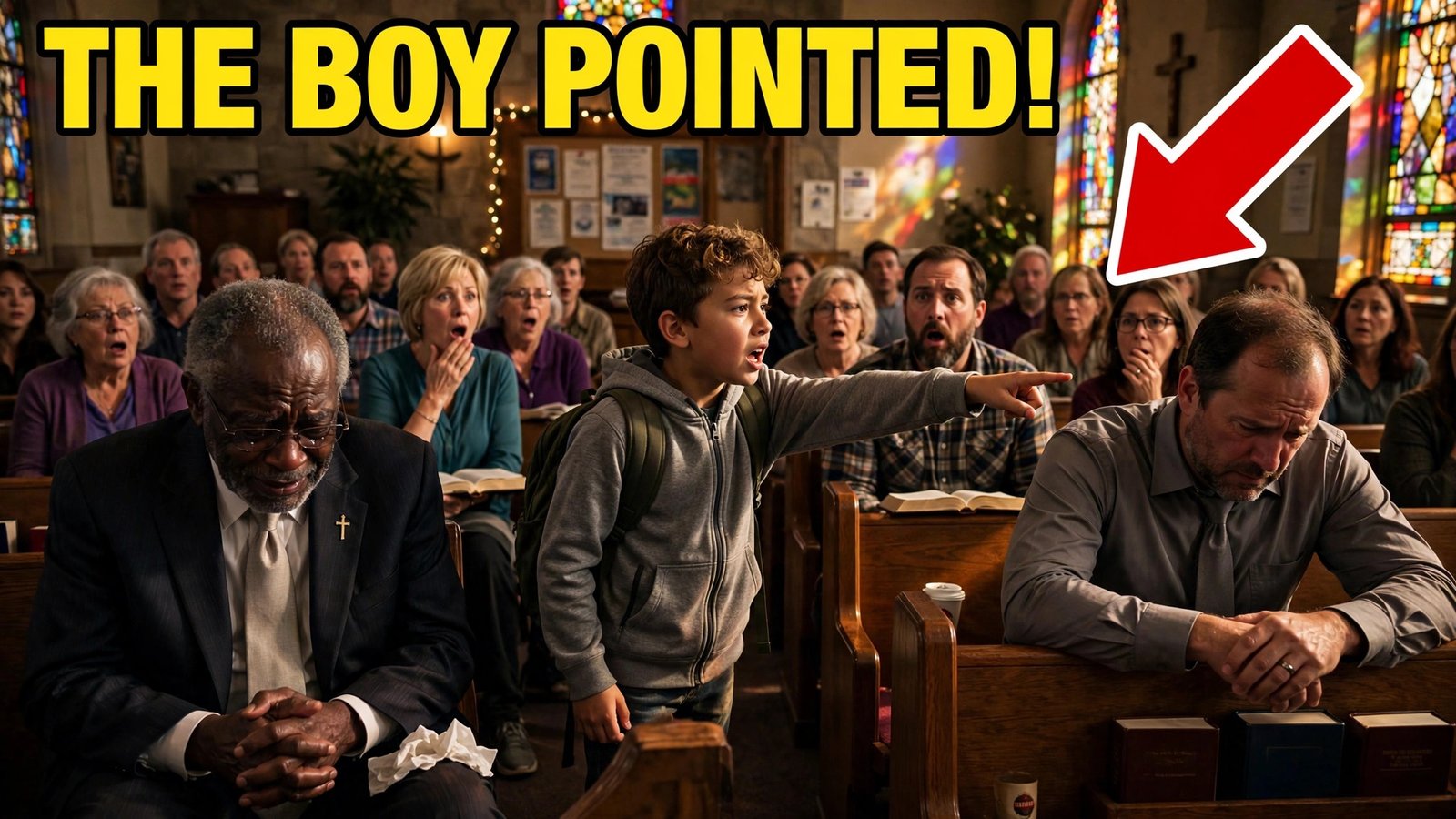
Twelve-year-old Tommy Beck stood in the doorway in his grass-stained sneakers. His mother grabbed for his arm. He stepped out of her reach.
“Tommy, sit down,” Pastor Reed said gently. “This is grown folks’ business.”
“I saw him,” Tommy said. “I saw who took the money.”
The fellowship hall went dead silent.
Tommy’s face was white. His hands were jammed in his pockets. He looked at Deacon Amos, who was staring at him with something like terror.
“Son,” said his father, rising from the second row. Martin Beck. The church’s new treasurer, appointed in February. “Whatever you think you saw—”
“I saw YOU, Dad.”
The words landed like a dropped hymnbook.
Martin Beck froze halfway out of his chair.
“Tommy,” his mother whispered. “What are you saying?”
“In April,” Tommy said, his voice cracking. “I came to bring you your lunch because you forgot it. The office door was open. You were at the copy machine with the ledger. You tore out a page and put it in your briefcase.”
Martin’s face went the color of old milk.
“You’re confused,” he said. “You were— you must have dreamed that.”
“I didn’t dream it.” Tommy’s voice got stronger. “And I saw the money too. In the garage. In a toolbox under your workbench. Banded bank stacks. I counted the bands, Dad. I thought maybe it was for a surprise.”
Mrs. Beck made a sound like air leaving a tire.
Pastor Reed found his voice. “Martin. Is this true?”
Martin looked at his son. At his wife. At two hundred faces.
“I can explain,” he said.
CHAPTER 4 – THE MISSING PAGE
The sheriff’s deputy arrived twenty minutes later. By then, Martin Beck had stopped saying “I can explain” and started saying “I want a lawyer.”
But Tommy wasn’t done.
“The page,” he told the deputy. “He tore it out of the ledger. If you find the page, you’ll know where the money went.”
They searched the church office. They searched Martin’s briefcase, his car, his garage. The toolbox was empty — the money was gone from there too, moved somewhere, nobody knew where yet.
But in Martin’s home office, taped inside the back cover of a Bible nobody had opened in years, they found it.
The missing ledger page.
Pastor Reed read it in front of the whole congregation, his hands shaking so badly the deputy had to hold the paper steady.
It was a record of every withdrawal. Dates. Amounts. And at the bottom, in Martin Beck’s own handwriting, a note:
Transfer complete. They’ll never check the second account.
“Second account?” the deputy said.
Martin closed his eyes.
And Deacon Amos — the man who’d sat through an hour of accusations without defending himself — finally stood up.
“Pastor,” he said, his voice clear for the first time all night. “May I speak now?”
CHAPTER 5 – WHY HE STAYED SILENT
“I knew in May,” Amos said.
The room leaned forward as one body.
“The bank sent a duplicate statement to the church by mistake. I saw the withdrawals. I recognized Martin’s signature on the slips — he’d been practicing it, but a man’s hand doesn’t change at seventy-eight years of watching.”
He looked at Martin, who wouldn’t meet his eyes.
“I went to his house. Sat at his kitchen table. Told him I knew.”
“What did he say?” Pastor Reed asked.
“He cried,” Amos said simply. “Told me his business was failing. Told me he’d pay it back before anybody noticed. Begged me not to tell — said it would destroy his family.”
Amos’s voice broke.
“So I gave him thirty days. Then sixty. I covered the ledger entries so the board wouldn’t see, thinking I was buying him time to make it right. Every Sunday I prayed he’d walk in and confess. Every Sunday he didn’t.”
“You protected him,” Carol Denning whispered.
“I sinned,” Amos corrected, and the word fell like a stone into still water. “I thought mercy meant silence. I was wrong. When you came for me tonight, I couldn’t defend myself, because the ledger was altered in MY handwriting. The cover-up was mine. The theft was his. I couldn’t say one without confessing the other.”
Tommy was crying now, standing between his parents like a fence post between two collapsing barns.
“I’m sorry, Deacon Amos,” the boy said.
Amos walked to him — slow, aching steps — and put his weathered hands on the boy’s shoulders.
“Son,” he said, “you did the bravest thing I’ve seen in fifty-two years in this church. You told the truth when it cost you everything. Don’t you ever be sorry for that.”
CHAPTER 6 – THE PAGE’S SECRET
The deputy bagged the ledger page as evidence. But Pastor Reed had seen the last line. Everyone had heard him read it.
Transfer complete. They’ll never check the second account.
“What second account?” Ray Pruitt demanded.
Martin finally spoke, his voice hollow.
“There’s no renovation money anymore,” he said. “It’s gone. All of it.”
Gasps. Someone screamed.
But the deputy held up a hand. “Mr. Beck. The page says ‘transfer complete.’ Transfer to WHERE?”
Martin stared at the floor for a long time.
And when he finally answered, his voice was barely a whisper — and what he said made Deacon Amos sink back into his chair like he’d been struck.
Because the money hadn’t just been stolen.
It had been sent somewhere. To someone. For something.
And the name on that second account was a name every person in that fellowship hall knew.
The deputy read it off the page, slowly, and the room went so quiet you could hear the old building settle.
To be continued.