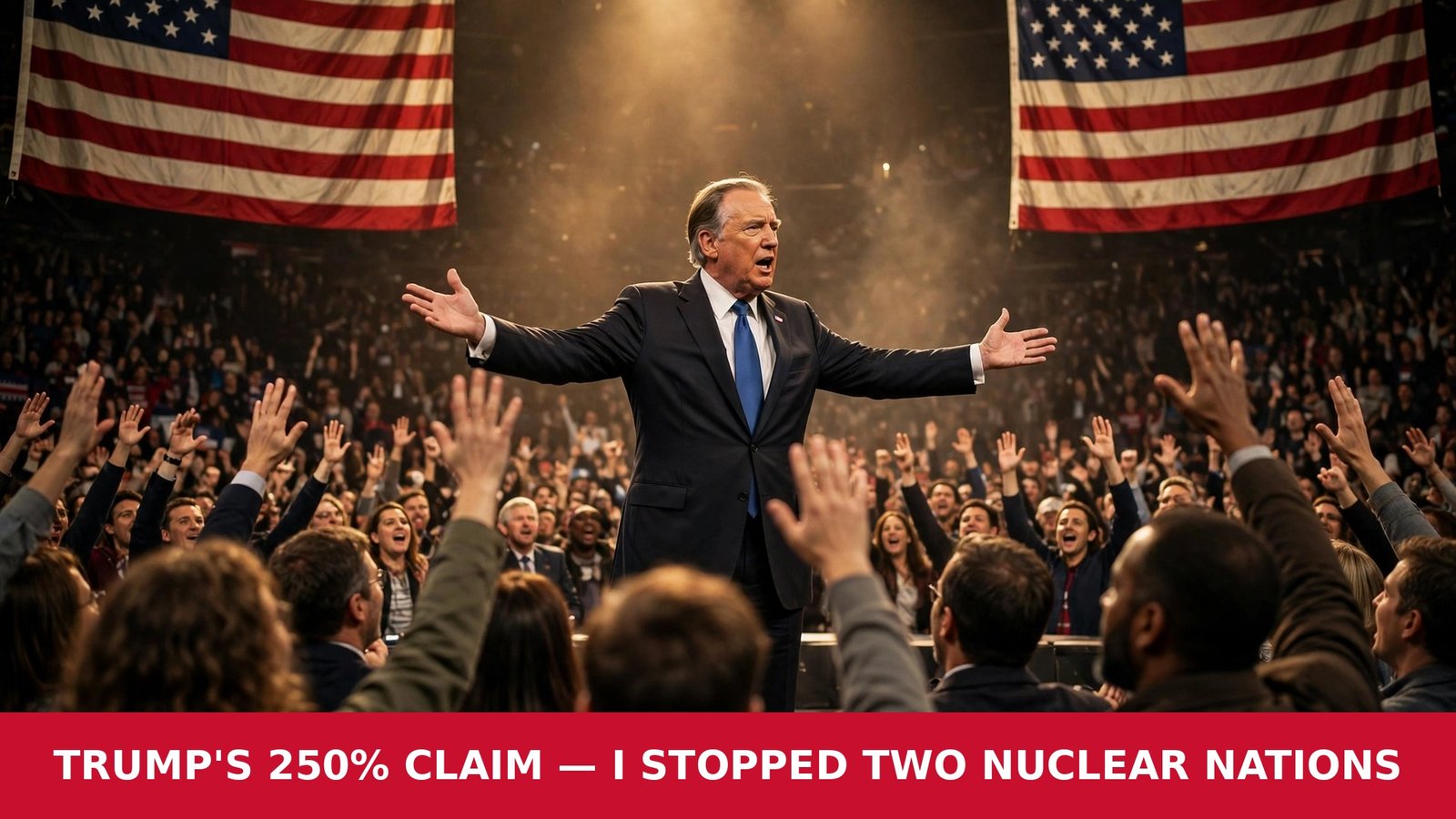
The rally crowd in Fort Myers had already heard plenty. Then Donald Trump turned to the story he loves telling most: the war he says he stopped.
Speaking Friday, October 23, at Alico Arena on the campus of Florida Gulf Coast University, the president repeated his claim that he prevented India and Pakistan from escalating their 2025 war — not with diplomacy, he said, but with the threat of crushing tariffs.
"You stop India and Pakistan, two nuclear nations," Trump told the crowd, before launching into his version of the phone calls. "I said, 'Fellas, if you guys are going to do that, you're not going to trade with the United States… I'm going to put massive tariffs on both of you, 250 per cent, so you won't be able to do any business'."
Then, in his telling, the shooting stopped.
The claim, in his own words
Trump's account was vivid and characteristically blunt. The two sides were angry, he said, but the tariff threat changed the calculation. Trade with America, the world's biggest market, was simply too valuable to lose.
He claimed "eleven planes were shot" during the conflict — a figure he offered without elaboration — and then widened the boast. "I've settled eight wars. Did I get the Nobel Prize? No," he said, to cheers from the arena.
It is a story Trump has told before, and each retelling seems to sharpen the edges. The tariff number grows, the drama rises, and the punchline — the Nobel Prize that never came — lands exactly where he wants it.
What actually happened in May 2025
The conflict Trump is describing is real, and it was terrifying while it lasted.
India launched Operation Sindoor in May 2025, days after the April 22 Pahalgam attack. For several days, two nuclear-armed neighbors exchanged fire, and the world watched with genuine alarm. On May 10, the shooting paused.
Where accounts diverge is on why.
India has consistently denied any third-party mediation in ending the conflict. New Delhi's position is that the May 10 pause came after Pakistan's Director General of Military Operations approached India's DGMO directly — a military-to-military channel, not a deal brokered from Washington.
That denial has not changed, no matter how often Trump has repeated his version. And it is important to keep the two accounts separate: what Trump says happened, and what India says happened, are not the same story.
Why he keeps telling it
So why does this story keep returning to Trump's rally speeches, more than a year later?
Partly, it is about image — a president who stared down two nuclear powers looks, to his supporters, larger than any diplomat. Partly, it is about the Nobel Prize, a grievance he has aired repeatedly. And partly, it is about the midterms: with November 3 days away, Trump is reminding voters of the dealmaker brand he built his career on.
Claim versus record
None of this makes Trump's story impossible to believe in its broad strokes — American presidents do talk to foreign leaders during crises, and trade pressure is a real tool of statecraft. But the specific claim — that a 250% tariff threat was the decisive factor — remains his claim, not an established fact. India says otherwise, and no independent account has confirmed his version of the calls.
That distinction matters. Voters and readers deserve to hear the president's words in full, and to hear the other side's answer with equal clarity.
Trump will almost certainly tell this story again. It plays too well in an arena to retire. But every time he does, the gap between his telling and New Delhi's denial will be there too — a reminder that in international politics, the loudest story is not always the settled one.
Sources: News18, New Indian Express, Telegraph India (October 24, 2026).