CHAPTER 1 – THE ORDER HE WOULDN’T FOLLOW
“Sergeant Cole, I am giving you a direct order.”
The parade ground went dead silent.
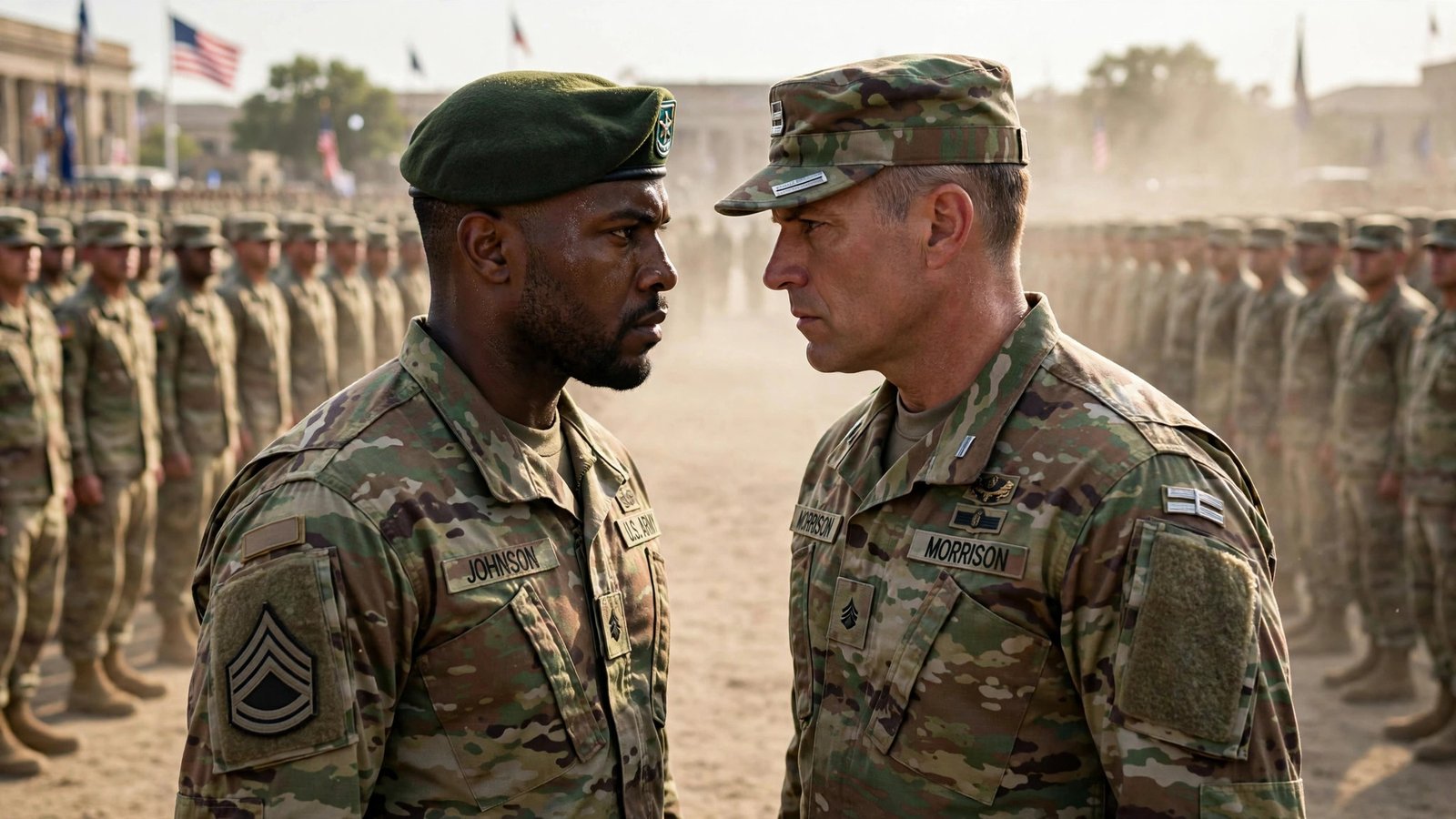
Two hundred soldiers stood in formation under the Georgia sun. Every one of us was staring at the same patch of dirt in the middle of the field, where Sergeant Marcus Cole stood at attention, jaw locked, eyes straight ahead.
And did not move.
Captain Reeves’ face went from pink to red. “Sergeant. Move your squad to the east compound. Now.”
“I respectfully decline, sir.”
A ripple ran through the formation. Somebody’s rifle shifted against a shoulder. Behind me, somebody whispered, “Did he just say—”
“You don’t get to decline.” Reeves stepped in close, close enough that the bodycam on his chest caught every word. “That’s not how any of this works, Sergeant.”
“Then court-martial me, sir.”
I was standing in third rank, close enough to see the sweat running down Marcus’s neck. I’d served under Sergeant Cole for fourteen months. I’d seen him carry a wounded private two miles in full kit. I’d seen him give his own MRE to a kid at a checkpoint.
I’d never seen him disobey anything.
Reeves leaned in. His voice dropped, but the bodycam still caught it.
“You want to do this here? In front of everybody?”
“Yes, sir,” Marcus said. “I do.”
That was when Lieutenant Parks, standing off to the side with the other officers, muttered something under his breath. I didn’t catch all of it. I caught enough.
A couple of soldiers near me went still. One of them, Private Okafor, closed his eyes like he was counting to ten.
Marcus heard it too. Everybody heard it.
He didn’t react. Not even a flicker. He just kept his eyes on Reeves.
“Sir,” Marcus said, loud enough for the back rank to hear, “if you want my squad inside that compound, you’re going to have to explain to these soldiers why.”
Reeves stared at him. “Explain? I don’t explain orders, Sergeant.”
“Then I won’t follow this one.”
THE COMPOUND
Here’s what you need to understand about the east compound.
It was a half-collapsed storage site outside the wire, three concrete buildings and a yard full of rusted trucks. Command said it was empty. Command said a weapons cache might be buried under the floor of Building Two, and they wanted it cleared before the inspection team arrived on Thursday.
Fast. Quiet. No questions.
The briefing that morning had lasted six minutes. Six minutes, and then we were marched out to the parade ground for what was supposed to be a routine movement order.
Only it wasn’t routine. Because Marcus had been on the night desk, and the night desk sees the drone feeds.
At 0300 hours, a thermal drone had swept the east compound. Marcus had watched the feed himself. He’d logged it. He’d flagged it.
Three heat signatures in Building Two. Small ones.
Not weapons. People.
“Sir,” Marcus said on the parade ground, “Building Two is not empty.”
Reeves didn’t blink. “Intel says it is.”
“Intel is wrong, sir. I watched the thermal feed at zero-three-hundred. There are civilians in there. Looks like a family.”
“Sergeant—”
“And the clearance method you’re ordering,” Marcus kept going, his voice steady as stone, “involves breaching charges on a structure with a compromised roof. If we go in the way you want us to go in, that roof comes down. On them.”
The silence on that field had weight. You could feel it pressing on your ears.
Reeves’ jaw worked. “Are you calling me a liar, Sergeant?”
“I’m telling you what I saw, sir.”
“And I’m telling you the building is clear.” Reeves turned to the formation, raising his voice. “Does anyone else want to question this order?”
Nobody moved. Two hundred soldiers, and you could’ve heard a pin drop on concrete.
That’s when the phones started coming out.
Not many. Just a few, held low, at the edges of the formation. Somebody was filming. Of course somebody was filming.
THE ARREST
Reeves didn’t wait for the field to clear.
“Sergeant Cole,” he said, “you are relieved. MPs will escort you to quarters pending review.”
Two MPs stepped forward. Marcus unclipped his sidearm slowly, deliberately, and handed it over grip-first. The whole formation watched. Nobody breathed.
As they walked him past the officers’ line, Lieutenant Parks said it again — louder this time, like he wanted the phones to catch it.
Marcus stopped walking.
He turned his head, slow, and looked Parks dead in the eye. “Say it to my face, Lieutenant.”
Parks opened his mouth. Then Major Ellis — who’d been watching from the edge of the field with her arms crossed — took three steps forward.
“Lieutenant,” she said, “that’s enough.”
Just three words. But her voice cut across that field like a blade, and Parks shut his mouth so fast I heard his teeth click.
Major Ellis looked at Marcus. Something passed between them — I couldn’t read it. Respect, maybe. Or warning.
“Sergeant,” she said quietly, “go with them.”
Marcus nodded once and kept walking. The MPs fell in beside him. The formation stayed frozen until the three of them disappeared behind the barracks.
Then the field exploded.
Not literally. But the shouting started — soldiers arguing in clusters, sergeants yelling for order, somebody’s voice cracking as he screamed that Marcus had just saved lives and this was how they thanked him.
I stood there in third rank and thought about the thermal feed. Three small heat signatures. A family, hiding in a concrete box, with no idea that two hundred soldiers had just argued about whether they existed.
THE SPLIT
By noon, the video was everywhere on base.
By 1400, the base was split clean in half.
In the barracks, it was all anybody talked about. Half the guys said Marcus was a hero — “he just saved some family from getting buried, man, how is that even a question.” The other half said rules are rules — “you can’t just refuse orders because you feel like it, the whole thing falls apart.”
And then there was the third conversation. The ugly one. The one happening in corners and DMs.
Somebody posted the clip with a caption about “people like him” always thinking the rules don’t apply. Somebody else replied with something worse. Within an hour, it wasn’t about the compound anymore. It was about everything else.
Private Okafor found me by the motor pool that afternoon. He looked tired.
“You think he did the right thing?” he asked.
I didn’t answer right away. “You saw the thermal log?”
“I saw it. Three signatures. Small.”
“Then you know.”
He nodded slowly. “Yeah. I know. But Danny—” He stopped. “Half the base thinks he grandstanded. The other half thinks he’s a hero. Nobody’s talking about the family in the building.”
That stuck with me. He was right. The family had disappeared from the conversation completely.
THE FOOTAGE
At 1900 hours, Captain Reeves called a formation. His face was calm now. Too calm.
“Earlier today,” he said, “Sergeant Cole made a claim about civilian presence in the east compound. A review of the drone footage has been conducted.”
My stomach dropped. I already knew where this was going.
“The footage,” Reeves said, “shows no heat signatures in Building Two. The building is clear. Sergeant Cole was mistaken.”
A murmur ran through the ranks. I looked for Marcus. He wasn’t in formation. He’d been confined to quarters since noon, pending review.
“Furthermore,” Reeves continued, “the thermal log Sergeant Cole claims to have seen has been reviewed and found to be—” he paused, choosing the word carefully, “—corrupted. A sensor malfunction.”
Corrupted. Just like that.
I felt Okafor tense beside me. He’d seen the same log I had. It wasn’t corrupted at 0300. We both knew it.
After dismissal, I went back to the barracks and sat on my bunk and stared at the wall. Something was wrong. Not just wrong — rotten. A sergeant with a spotless fourteen-year record doesn’t throw his career away on a malfunction.
At 2140, my phone buzzed. Unknown number.
Four words.
“They erased it. I have a copy.”
My hands went cold.
Another message came through before I could reply.
“Roof access. Motor pool. 0200. Come alone.”
I stared at the screen until it went dark.
Outside my window, the base was quiet. Too quiet. Somewhere across the compound, in a dark room, Sergeant Marcus Cole was sitting alone, waiting to find out if his career — his whole life — was over.
And somewhere out there was a copy of the footage that proved he’d been right all along.
The only question was who had it.
And what they wanted in return.
To be continued…